
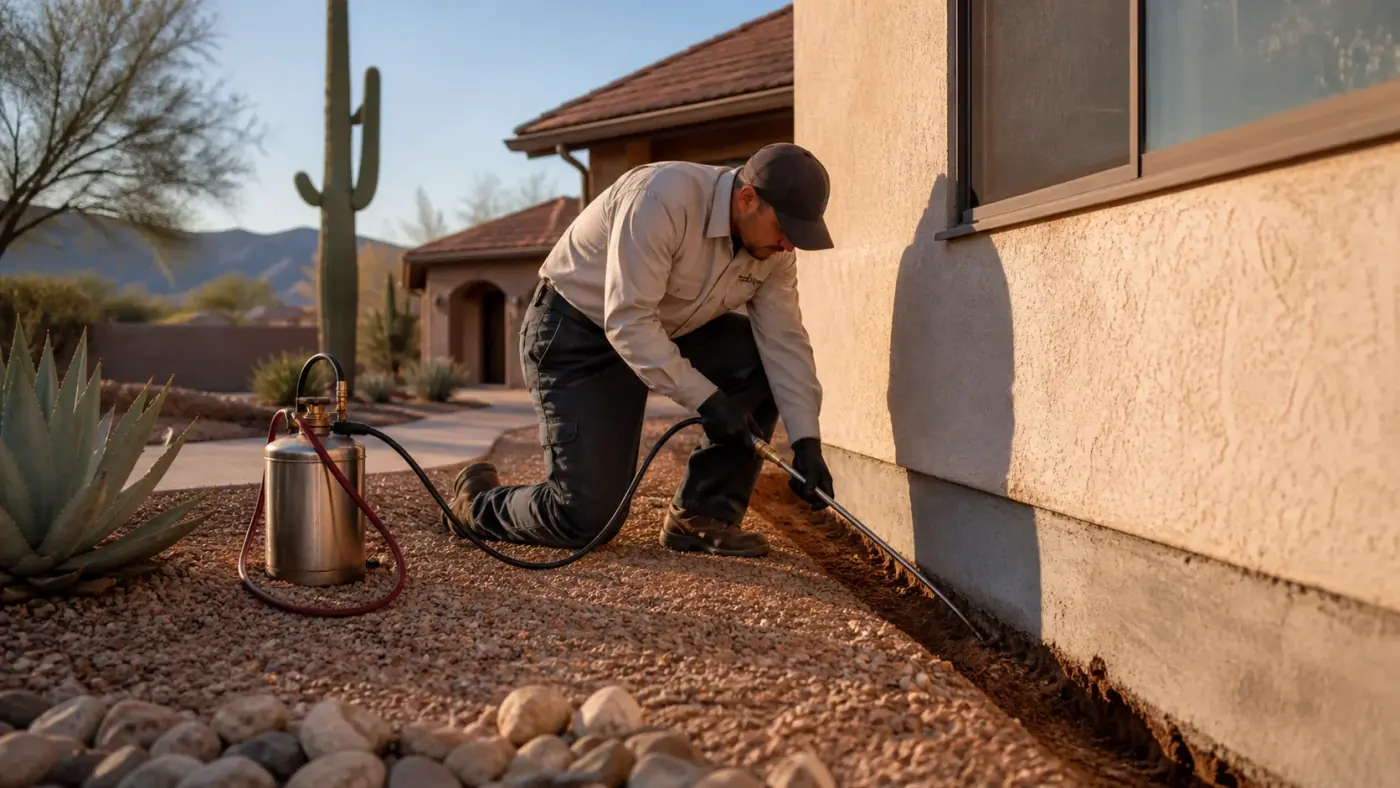
Why termites are a Tucson problem, not a maybe
The desert subterranean termite is the termite that eats Tucson homes. The University of Arizona Cooperative Extension identifies it as the most common and economically important termite in southern Arizona, and it thrives in exactly the conditions our neighborhoods offer: warm soil, slab foundations, and irrigation that keeps the ground near the house damp. Colonies live underground and travel up through soil, cracks and expansion joints to reach wood.
Here is the part newer residents miss. A Tucson home does not need to be old or neglected to have termites. Slab-on-grade construction puts wood framing a few inches from the soil, and a single hairline crack in the slab is a highway. Homes in Marana, Oro Valley and Sahuarita built in the last fifteen years get treated every week.
Signs you are looking at termites
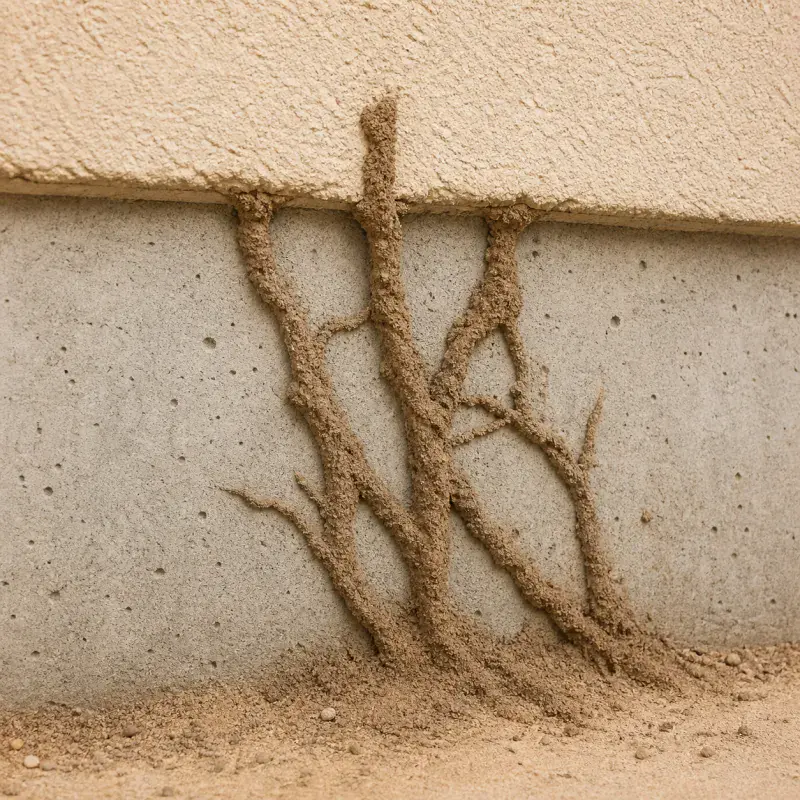
Mud tubes are the giveaway. Pencil-width tunnels of dried soil climbing a stem wall, a garage post, or hanging from a ceiling are built by desert subterranean termites to stay moist while they travel. Other signs Tucson providers see constantly:
- Small dirt tubes dropping from a ceiling or out of a ceiling crack, often in the garage
- Paint that bubbles or looks water-damaged on a wall with no plumbing behind it
- Wood that sounds papery or hollow when tapped, especially baseboards and door frames
- A sudden swarm of winged insects indoors or around exterior lights after a monsoon rain
- Piles of discarded wings on window sills
If you are not sure whether a tube is active, break off a one-inch section and check it a few days later. Termites repair active tubes quickly. Either way, a licensed inspector can confirm it in one visit, and our guide to what happens during a termite inspection in Tucson walks through where they look and what paperwork the visit produces.
Termite season in Tucson: when swarms happen
Desert subterranean termites in Tucson swarm after the first heavy monsoon rains, typically July through September, with daytime swarms following storms. That is when most homeowners first notice a problem, but the colony was feeding long before the swarm. Foraging continues year round in Tucson because the soil rarely gets cold enough to stop it, so there is no off-season where an inspection is pointless.
Quick rule: swarmers inside the house mean the colony is inside or under the slab. Swarmers only outside may be coming from a neighbor's yard or a stump. Both are worth a call, but the first one is urgent.
If you want the full picture of why the flights follow the storms and how to tell a termite swarmer from a winged ant, read our guide to termite swarm season in Tucson.
How Tucson termite treatment works
Two treatment methods dominate the Tucson market, and a licensed provider will recommend one based on the inspection.
| Method | How it works | Best fit |
|---|---|---|
| Liquid soil treatment | A trench is dug along the foundation and a non-repellent termiticide is applied to the soil, often with drilling through slabs or patios at entry points. Termites carry it back to the colony. | Active infestations, slab homes, most Tucson properties |
| Bait stations | Stations are set in the soil around the perimeter and monitored. Termites feed on the bait and spread it through the colony over weeks to months. | Homes with barriers to trenching, ongoing monitoring, owners who want less chemical volume |
| Spot treatment | Foam or liquid applied to a specific wall void or tube location. | Small, localized activity confirmed by inspection |
Expect the provider to map every tube location, drill where the slab meets the stem wall if needed, and document the treatment. Arizona requires licensed termite providers to file a Termite Action Report with the state for treatments, which is useful paper to have when you sell the house.
Typical termite treatment cost in Tucson
These are typical market ranges reported across the Tucson metro, not a quote. The provider you are connected with sets the actual price after inspecting the home.
| Service | Typical Tucson range |
|---|---|
| Termite inspection | Often free with treatment, otherwise roughly $75 to $150 |
| Liquid treatment, average single-family home | Roughly $800 to $2,500 depending on linear footage and drilling |
| Bait station system with monitoring | Roughly $1,200 to $3,000 for install, plus an annual monitoring fee |
| Spot treatment | Roughly $250 to $700 |
| Annual renewal or warranty | Roughly $150 to $350 per year |
What moves the price: the perimeter footage of the slab, how much concrete has to be drilled, whether the home has an attached garage or multiple additions, and the warranty term. For a deeper breakdown read our Tucson termite treatment cost guide.
What to check before you hire
Every pest control business and applicator in Arizona must be licensed through the Arizona Department of Agriculture, Pest Management Division. Ask for the license number and check it. Beyond that, the questions worth asking on the first call:
- Which termiticide will be used, and is it non-repellent?
- Does the price include drilling through the patio, garage slab or expansion joints?
- What does the warranty cover, and is it transferable to a buyer?
- Will a Termite Action Report be filed with the state?
The providers in our network are independent and licensed. When you call, you are routed to one that covers your ZIP code, whether that is central Tucson, Oro Valley, Marana or Sahuarita.
How the call works
- Tell us what you are seeing. Scorpions in the garage, mud tubes on the stem wall, a rat in the engine bay. A few details are enough.
- Get routed by ZIP code. Your call goes to an independent, licensed provider that actually covers your part of the Tucson metro.
- Book on the same call. Most providers can quote an inspection or treatment window right away.
Same-day or overnight service depends on which providers are taking calls in your part of Tucson, how many technicians are free and how busy the week is. Nobody can promise it, and capacity shifts from one neighborhood and one week to the next.
Frequently asked questions
How do I know if the mud tubes on my wall are active?
Break off a one-inch section of the tube and check it in two or three days. Desert subterranean termites repair active tubes quickly, so a rebuilt gap means they are still working. A licensed inspector can also probe the tube and surrounding wood to confirm activity in a single visit.
Is termite treatment in Tucson a one-time job?
Usually no. Liquid soil treatments typically protect a home for several years and most providers offer an annual renewal that keeps a warranty in force. Bait systems need ongoing monitoring. Because desert subterranean termites forage year round in Tucson, periodic inspections are part of owning a home here.
Do new homes in Tucson need termite treatment?
Often yes. Arizona builders apply a pre-construction soil treatment, but that protection fades over time and new construction on former desert land sits directly on established colonies. Providers treat homes in Marana, Sahuarita and Oro Valley subdivisions that are well under ten years old on a regular basis.
Will I need to leave the house during treatment?
For a standard liquid perimeter treatment, most homeowners stay home. The work happens outside along the foundation and in the garage, and the products used are applied to soil, not living spaces. Your provider will tell you if any room needs to be vacated during drilling.