
Pest control in Sahuarita: what actually shows up here
Roof rats, pack rats and desert subterranean termites are the three calls Sahuarita providers get most, followed by scorpions, roaches and mosquitoes around the lake and the river. Sahuarita incorporated in 1994 and counted about 34,000 residents at the 2020 census, most of them in homes built since 2000, so this is not an old-house pest profile. It is a food-and-water profile.
| Pest | Where it shows up in Sahuarita | Service |
|---|---|---|
| Roof rats | Streets nearest the pecan orchards and the Santa Cruz River, mature landscaping around Sahuarita Lake | Rodent control |
| Pack rats | Desert edges of Madera Highlands and Quail Creek, engine bays | Pack rat control |
| Desert subterranean termites | Slab homes across Rancho Sahuarita, many now past the three-year pretreatment window | Termite control |
| Arizona bark scorpion | Block walls and garages on the newer desert-edge lots | Scorpion control |
| Mosquitoes | Lakefront and park edges after monsoon rain, yard drains and plant saucers | Mosquito control |
| American cockroaches | Floor drains and irrigation boxes | Cockroach control |
Sahuarita homes and why pests like them
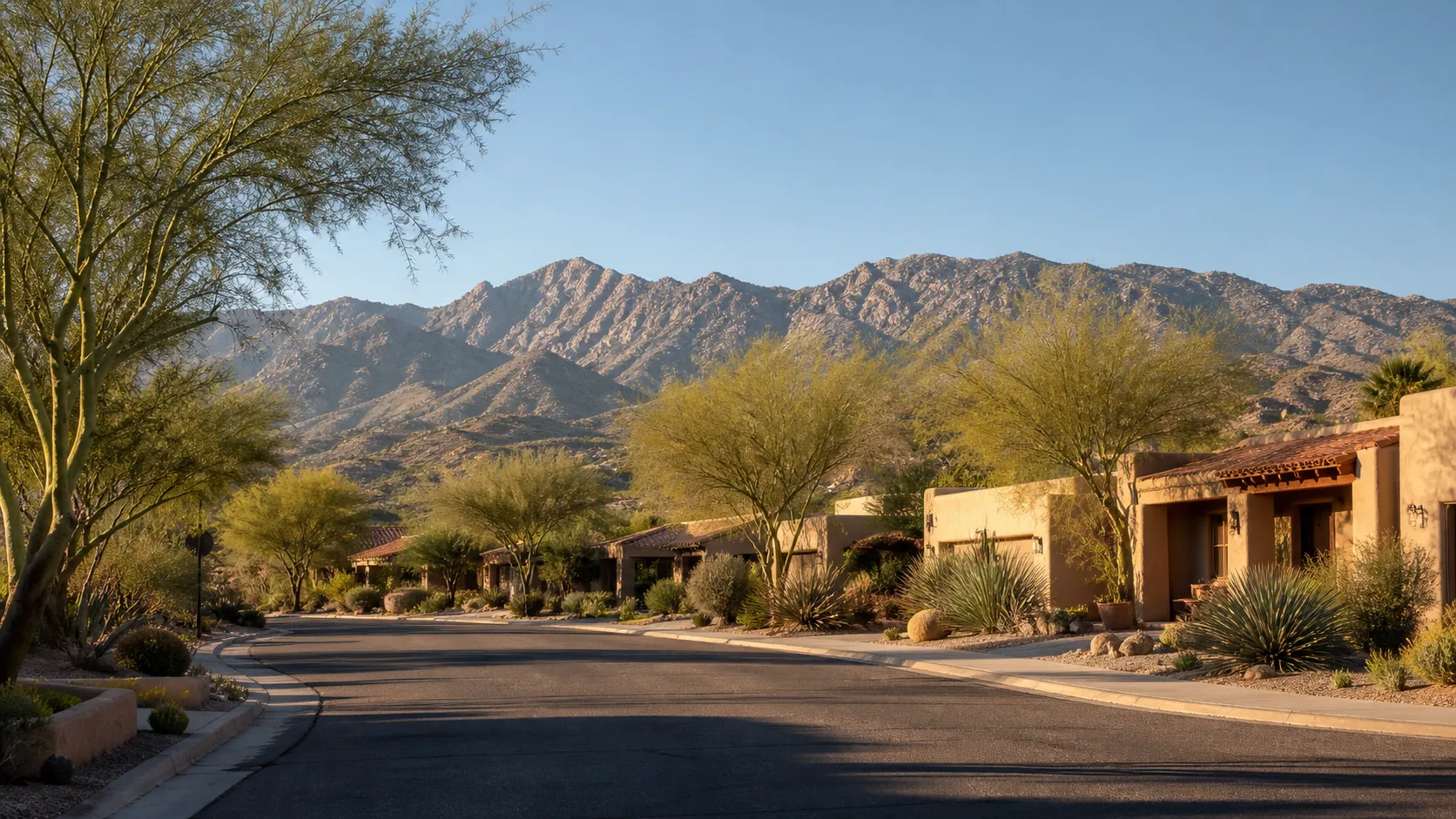
Sahuarita is a young town of slab-built stucco homes wrapped around a giant food source. Rancho Sahuarita started going up in the early 2000s and its 10-acre Sahuarita Lake opened to the public in 2001; homes there and in Madera Highlands, La Joya, Los Arroyos and the age-restricted Quail Creek are mostly one to twenty-five years old. Then there are the pecans. Farmers Investment Co., the company behind Green Valley Pecan, farms roughly 7,000 acres along the Santa Cruz River through Sahuarita and describes it as the largest irrigated pecan orchard in the world. The shelling plant closed at the end of 2021, but the trees are still farmed.
University of California researchers who study orchard rodents report that roof rats prefer nuts such as walnuts, pecans and almonds, and the University of Arizona Cooperative Extension notes that roof rats travel several hundred feet in a night and need free water such as landscape irrigation. An irrigated orchard, a river corridor and a lake next to thousands of lawns on drip lines: that is the whole explanation. Pack rats work the desert side of the equation, nesting in cholla and prickly pear at the edges of Madera Highlands and Quail Creek and in the engine bays of cars that sit.

Seasonal pattern in Sahuarita
Rodent calls in Sahuarita peak from October through February, when pecans come off the trees and nights turn cold and roof rats head for attics and garages. Termite swarms follow the monsoon storms from July into September. Scorpions are a May through September problem on the newer desert-edge lots. Mosquitoes around the lake and the river spike within a week of any heavy monsoon rain, and the Aedes mosquitoes that breed in yards need only a bottle cap of standing water, so plant saucers and yard drains matter as much as the lake does. Spring is the quiet window and the right time to have entry points sealed before the next rodent season.
When to seek care: a bark scorpion sting rarely needs an emergency room for a healthy adult, but the University of Arizona notes that young children face the greatest risk of serious symptoms. Call the Poison Help line at 1-800-222-1222, answered for Pima County by the Arizona Poison and Drug Information Center in Tucson, and they will tell you whether to go in.
Typical Sahuarita pest control prices
These are typical market ranges across the Tucson metro, not a quote. The provider you are connected with sets the price after seeing the home.
| Service | Typical Sahuarita range |
|---|---|
| Initial general pest service | Roughly $150 to $300 |
| Quarterly service, per visit | Roughly $100 to $200 |
| Roof rat trapping program, initial | Roughly $150 to $350 |
| Rodent exclusion (vents, gaps, roof line) | Roughly $200 to $600 as an add-on, more with attic cleanup |
| Termite liquid treatment | Roughly $800 to $2,500 |
| Mosquito treatment, per visit | Roughly $80 to $150 |
Sahuarita lots are uniform and close together, which keeps general pest pricing at the low end of the metro. Rodent work is the exception: sealing the roof line on a two-story home takes time, and time is what you pay for.
How the call works for Sahuarita addresses
Sahuarita addresses all fall in ZIP code 85629, and when you call, you are routed to a licensed local provider that covers it. Sonoran Pest Co is an independent referral service: we connect, the provider treats, and the provider sets the price. Ask for the Arizona Department of Agriculture, Pest Management Division license number before anyone sprays anything.
Mention which side of town you are on. A home backing the pecan rows wants a roof rat plan built on sealing and trapping, while a Madera Highlands lot against open desert wants pack rat and scorpion work. Quail Creek residents who leave for the summer should ask about a check of the garage and any parked car while they are gone. Nearby Green Valley has its own page, and the metro overview is on the Tucson pest control page.
How the call works
- Tell us what you are seeing. Scorpions in the garage, mud tubes on the stem wall, a rat in the engine bay. A few details are enough.
- Get routed by ZIP code. Your call goes to an independent, licensed provider that actually covers your part of the Tucson metro.
- Book on the same call. Most providers can quote an inspection or treatment window right away.
Same-day or overnight service depends on which providers are taking calls in your part of Tucson, how many technicians are free and how busy the week is. Nobody can promise it, and capacity shifts from one neighborhood and one week to the next.
Frequently asked questions
Do the pecan orchards really bring rats into Sahuarita neighborhoods?
The link is well documented in orchard research, if not in a Sahuarita-specific study. University of California researchers report that roof rats prefer nuts such as pecans, walnuts and almonds and nest at the base of orchard trees, and the University of Arizona Cooperative Extension puts their nightly range at several hundred feet. The first few streets from the rows see the most activity.
Is Rancho Sahuarita too new for termites?
No. Desert subterranean termites live in the soil under the subdivision and were there before the slabs. Arizona's pretreatment rule obligates the original applicator for three years; after that the barrier fades. Homes built between roughly 2003 and 2015 are squarely in the window where an inspection and, if needed, a liquid treatment make sense.
What about mosquitoes by Sahuarita Lake?
Treat your own yard first. The standing water that breeds Aedes mosquitoes is usually a drain, a saucer or a clogged gutter within a hundred yards of your door, not the lake. A provider can treat breeding spots and resting vegetation; pairing that with emptying every container after every storm is what actually works.
Why is my car the pack rat's favorite spot?
Because a warm engine bay out of the sun is a ready-made den. The white-throated woodrat builds nests in cholla and prickly pear and in the engine compartments of seldom-driven cars, and it chews wiring and hoses. Park in a closed garage when you can, clear cactus back from parking areas, and have any nest removed before it draws the kissing bugs that live in them.