
Which pack rat lives in Tucson
The Tucson pack rat is the white-throated woodrat, Neotoma albigula, which the University of Arizona Cooperative Extension lists as the pack rat most often met in Arizona's urban and suburban areas. It is native, not an import. Picture a softer roof rat: big dark eyes, big rounded ears, a furry tail instead of a scaly one, grey or cinnamon on top with a clean white throat. Head and body run 6 to 8 inches, the tail about the same again.
The old name is trade rat, and it is earned. Pack rats are drawn to small shiny things, coins, foil, a connector off a wiring harness, and will carry one off while leaving a twig behind in trade. Charming in a documentary. Less so under your hood.
One myth to kill on the spot: there is no pack rat and roof rat hybrid. The Cooperative Extension is blunt that the two come from different families and cannot interbreed, whatever the neighbor swears he saw in the alley.
Where pack rats build nests around Tucson homes
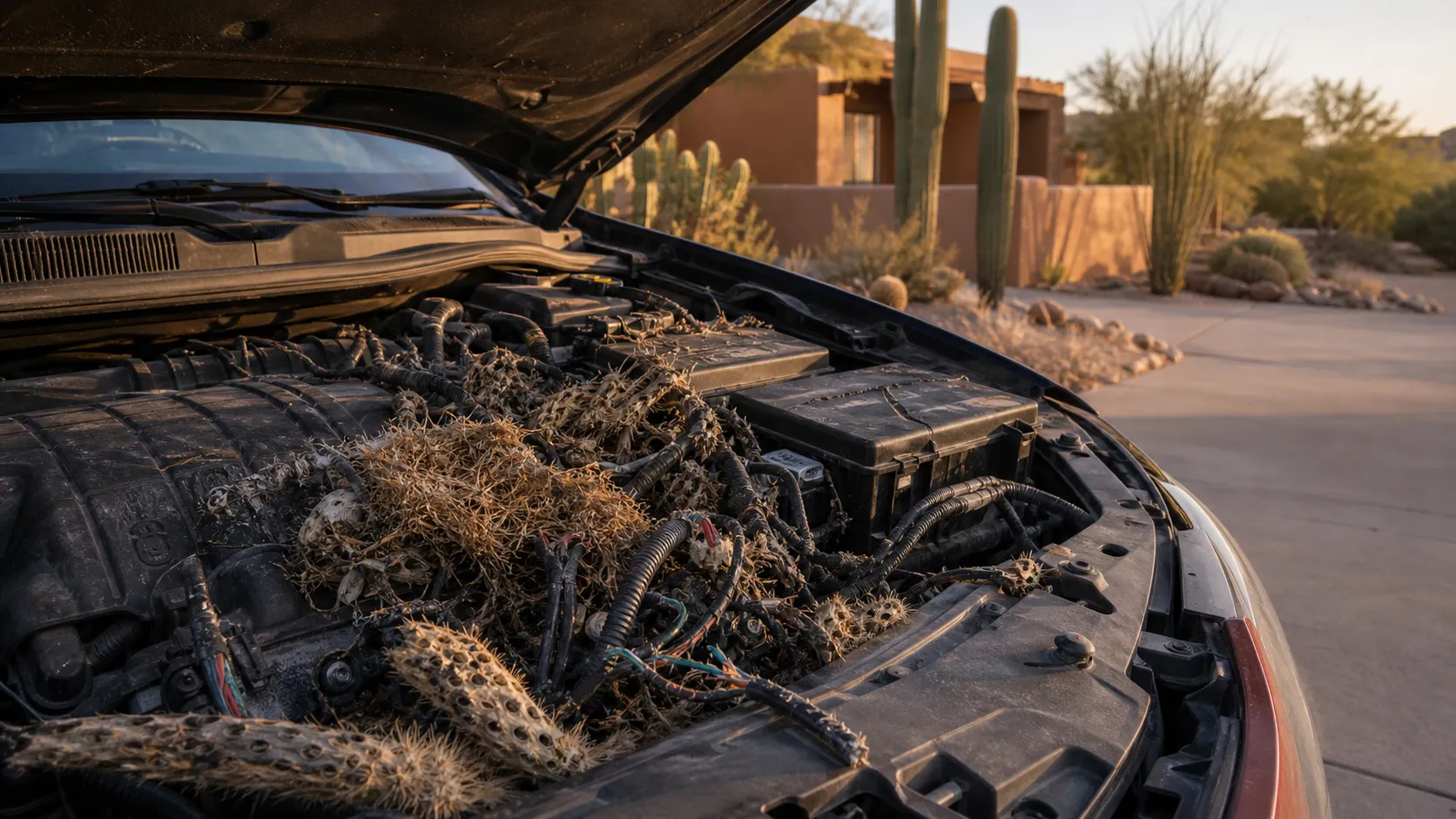
Pack rats build their nests, called middens, wherever something sharp or enclosed keeps coyotes and owls off them. In open desert that means the base of a cholla or a prickly pear, spines used as a fence. In a Tucson yard it means anything that imitates a cholla: a woodpile, the crawl space under a shed, the void behind pool equipment, the base of an air conditioning condenser, and the engine bay of any vehicle that sits still for more than a few nights. Already found one under your hood? Our guide to pack rats in your car engine walks through a safe cleanup and how to keep the next one out.
A mature ground midden is a real structure, 3 to 5 feet across and as tall by the Cooperative Extension's measure, with several chambers, stored food and a debris pile of leaves, plastic, paper and whatever the rat found interesting. A good nest is used for years, tenant after tenant, which is why the empty looking midden in the back corner keeps getting a new occupant. Pack rats even line the nest with aromatic leaves to hold down parasites. Smart animal. Still not one you want under the Camry.
Given access, they move into attics and wall voids too. Foothills homes with native landscaping right against the stucco see this most, and those calls often overlap with rodent control.

Signs of pack rats, and how to tell them from roof rats and mice
The sign that gives away a pack rat is the pile. No other Tucson rodent hauls sticks, cholla joints, dog food and stolen bolts into one heap. Beyond the pile, here is how the three rodents Tucson providers get called about compare, with sizes and droppings from the Cooperative Extension's identification table.
| Clue | Pack rat | Roof rat | House mouse |
|---|---|---|---|
| Nest | Stick and cactus midden on the ground, in a cholla, under a shed or in an engine bay | Hidden nest up high: attic, palm crown, vine on a fence, soffit | Shredded paper or insulation in a wall, drawer or garage cabinet |
| Droppings | Blunt, 1/2 to 3/4 inch, often piled in one latrine spot | Pointed, banana shaped, 1/4 to 1/2 inch, scattered along runways | Pointed, 1/8 to 1/4 inch, everywhere the mouse goes |
| Tail | Furry, two toned, about body length | Scaly, hairless, longer than the body | Thin, scaly, about body length |
| Where you meet it | Yard, shed, carport, vehicle, sometimes attic | Citrus trees, attic, utility lines at dusk | Kitchen, pantry, garage |
| Chewing | Wiring harnesses, drip irrigation, patio cushions | Attic wiring, citrus hollowed on the tree | Food packaging, small gnaw marks |
Oranges hollowed out on the tree with the rind still hanging are a roof rat sign, not a pack rat one, and our guide to roof rats in Tucson citrus trees covers that case.
Other tells: a check engine light after the car sat a week, drip lines leaking at chewed elbows, a musky smell under the shed, and the dog fixating on one corner of the yard at night.
What a pack rat nest really costs you
A pack rat midden threatens your wiring, your health and your sleep, and the wiring is the cheap part. A chewed harness commonly runs $500 to $2,000 or more to repair, and engine bays are where Tucson providers find most active nests. You will hear that newer cars use soy based wire insulation that rodents like. Maybe. Rodents gnaw wiring of every age because their front teeth never stop growing, so the 2009 truck is not safe either.
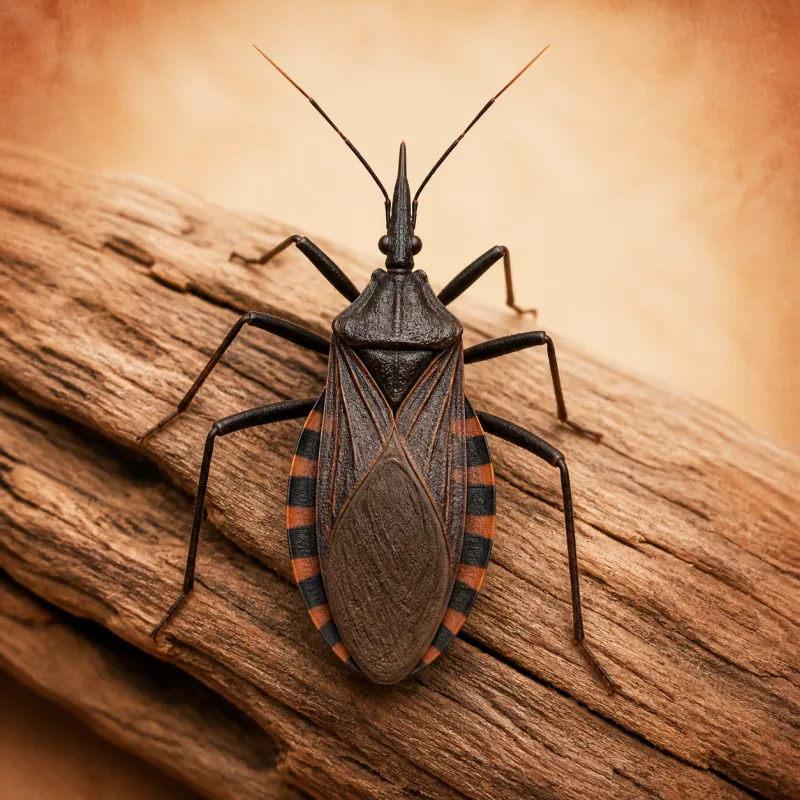
The health side is why this page takes pack rats seriously. The Cooperative Extension describes middens as common breeding sites for kissing bugs, the conenose bugs that feed on the rat at night and, when the nest sits against the house, crawl in through gaps and bite people instead. A University of Arizona team that collected kissing bugs in and around Tucson houses found 41.5 percent infected with Trypanosoma cruzi, the Chagas parasite, in a study published in Emerging Infectious Diseases in 2010. The bigger everyday risk is allergic: the Cooperative Extension warns that some people react more severely with each bite, up to life threatening reactions. The same nests hold fleas, ticks and mites, and white-throated woodrats carry arenaviruses that can infect people who breathe dust from disturbed droppings and nesting material.
If you are bitten by a kissing bug: most bites cause itching and swelling and nothing more. Call the Arizona Poison and Drug Information Center in Tucson or see a doctor right away for hives spreading beyond the bite, swelling of the face or throat, trouble breathing, dizziness or a racing heart. Our guide to kissing bug bite symptoms sorts the itchy welt from the reaction that needs an emergency room. Our kissing bug control page covers the rest.
Why poison is the wrong tool for pack rats
Rat poison is the wrong tool for pack rats in Tucson, for practical reasons before sentimental ones. A poisoned rat does not die in the bait box. It slows down and gets eaten, or it dies inside the wall void or engine bay it was living in, and you spend August smelling it. The Arizona Department of Agriculture's wildlife poisoning guidance asks anyone using anticoagulant baits to use them sparingly, in approved stations close to structures, and to collect carcasses daily, because of what happens next.
What happens next is secondary poisoning. Arizona Game and Fish wildlife health staff reported in 2018 that of 50 wildlife poisoning cases the department had documented since 2011, 41 involved anticoagulant rodenticide, and great horned owls were the most frequent victims. Owls, hawks and bobcats do a lot of free pack rat control in the Foothills and Oro Valley; poison takes that crew off the job. There is a legal layer too. The Cooperative Extension notes that native rodents like the pack rat are protected nongame mammals under Arizona law, with control permitted when they damage property or infest buildings, which is why licensed providers lean on trapping and exclusion. And poison does nothing about the midden, which is where the kissing bugs are.
How Tucson providers remove pack rats and keep them out
Real pack rat control is four jobs: dismantle the nest, trap the rat, seal what it was living in, and make the yard less inviting. Skip one and you are back on the phone by spring. When you call, you are routed by ZIP code to a licensed local provider, and the work usually runs like this:
- Inspection at pack rat height: cholla and prickly pear bases, woodpiles, under sheds and decks, behind pool equipment and condensers, and every engine bay on the lot.
- Nest removal. The midden is taken apart and bagged, treated for the kissing bugs, fleas and ticks inside it, and the spot disinfected using the wet cleanup method the Centers for Disease Control and Prevention recommends: no dry sweeping, soak first, then bag.
- Trapping. Snap or live traps on active runways, checked over one to three weeks. Pack rats are curious and trap well compared to roof rats, which is the one piece of good news on this page.
- Exclusion. Hardware cloth over shed skirting and crawl space vents, sealed gaps at the garage, and screening at the engine compartment of any stored vehicle.
- Habitat modification. Thin or remove cholla and prickly pear within a few yards of the house, clear woodpiles and debris, fix irrigation leaks, pick up fallen fruit and pet food. The Cooperative Extension puts sealing buildings and the places vehicles are kept ahead of everything else, and providers who get lasting results agree.
Expect follow up visits. A nest removed without trapping the occupant is half a job, and the occupant knows exactly where it used to live.
Typical pack rat removal cost in Tucson
These are typical market ranges seen across the Tucson metro, not a quote. The provider you are connected with inspects the property and sets the actual price.
| Service | Typical Tucson range |
|---|---|
| Inspection | Often free with service, otherwise roughly $50 to $150 |
| Single nest removal and cleanup | Roughly $150 to $400 per midden, more for attic or wall void nests |
| Trapping program, one to three weeks with follow ups | Roughly $200 to $800 |
| Exclusion of a shed, crawl space or garage | Roughly $300 to $1,500 depending on the number of openings |
| Habitat modification, cactus and debris removal | Roughly $150 to $600, often priced with a landscaper |
What moves the price: the number of active middens, whether a nest is inside a structure or a vehicle, how much cholla has to go, and how many trap checks the program needs. Every pest control business and applicator in Arizona must be licensed by the Arizona Department of Agriculture, Pest Management Division, so ask for the license number on the first call. Pack rat work is often folded into a broader plan; see pest control in Tucson for how those are built.
How the call works
- Tell us what you are seeing. Scorpions in the garage, mud tubes on the stem wall, a rat in the engine bay. A few details are enough.
- Get routed by ZIP code. Your call goes to an independent, licensed provider that actually covers your part of the Tucson metro.
- Book on the same call. Most providers can quote an inspection or treatment window right away.
Same-day or overnight service depends on which providers are taking calls in your part of Tucson, how many technicians are free and how busy the week is. Nobody can promise it, and capacity shifts from one neighborhood and one week to the next.
Frequently asked questions
Is it legal to trap pack rats in Arizona?
Yes, on your own property when they are damaging it. The University of Arizona Cooperative Extension notes pack rats are native nongame mammals protected under state law, with control allowed when they cause property damage or infest buildings. Licensed providers rely on trapping and exclusion rather than poison, which also keeps the owls and hawks that eat pack rats out of harm's way.
How do I keep pack rats out of my car in Tucson?
Move the car. A vehicle that sits for a week or two is the favorite nest site, so drive it, or at least pop the hood and shine a light in every few days. Park away from cholla and woodpiles, keep the garage door sealed at the bottom, and ask your provider about engine bay screening. Nothing replaces a weekly look under the hood.
Will removing the nest get rid of the kissing bugs too?
It removes their nursery, which is most of the battle. Kissing bug nymphs develop inside pack rat middens, so taking the midden apart and treating it cuts off the next generation. Adults already in the walls can linger for a season, so providers pair nest removal with sealing gaps around doors, windows and light fixtures and with cutting back porch lighting.
Do pack rats come back after removal?
A new one will try. Pack rats reuse good nest sites for years, and an empty midden is an open house. That is why providers take the nest apart completely, seal the structure it was in, and thin the cholla and prickly pear nearby. Homes that keep up the habitat work rarely see a second nest in the same spot.