
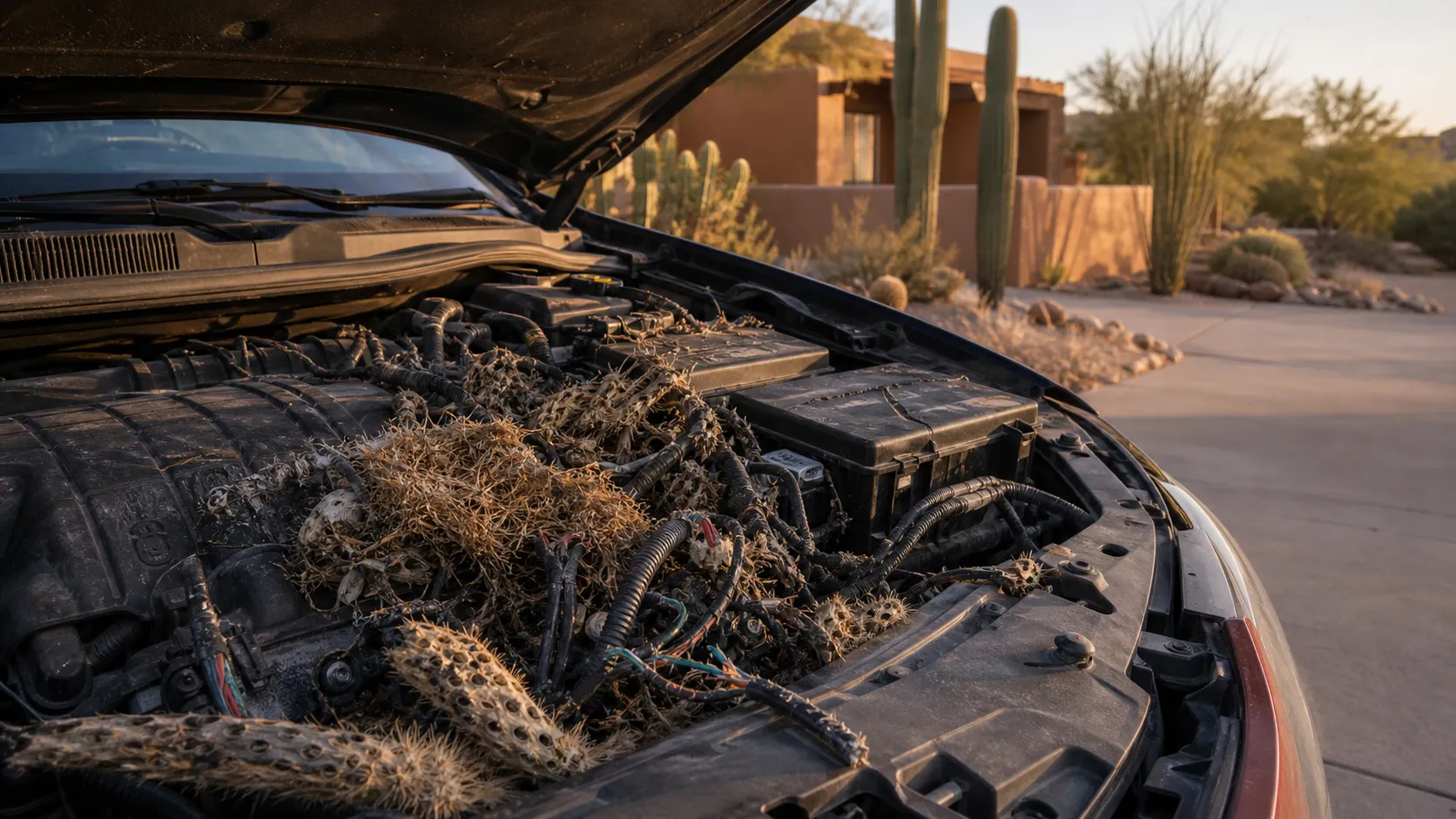
Why pack rats pick your engine bay
Pack rats pick Tucson engine bays because a parked car gives the white-throated woodrat everything a cholla does: cover from owls and coyotes, warmth after a cold desert night, and a dark cave nobody disturbs. A University of Arizona Cooperative Extension fact sheet on woodrats says they like to gnaw the vinyl or plastic shielding of electrical wires and are "notorious for chewing wiring of cars and appliances." That is the official language. Your mechanic has a shorter version.
The pattern is predictable. The second car that only goes out on weekends. The truck under the carport while you spend three weeks in Minnesota. The RV parked beside the wash all summer. Foothills and Oro Valley homes with native landscaping near the driveway see it most, but a car parked next to a woodpile in midtown qualifies too. A daily driver rarely hosts a full nest. The car that sits is the one that pays.
What a few quiet weeks can cost you
A pack rat left alone in a parked car for a few weeks can turn a normal start into a tow, and the damage happens quietly, a few inches from where you park every day. Picture it. You pull into the carport, lock up and fly out for a family visit. That first night a rat climbs the front tire, slips past the splash shield and finds the pocket above the transmission. By the end of the week it has hauled in cholla joints, mesquite pods, dog kibble from the patio and a strip of foam off your pool cover. It chews to keep its teeth in check, and the nearest thing to chew is the harness that runs to your sensors.
You get home, turn the key, and the dash lights up like a slot machine. Or nothing happens at all. When you open the hood there is a basket of sticks on the engine and a sharp musky smell, and the cabin air filter box may be packed with droppings, sitting right where the fan pulls air to blow at your face on a 105 degree afternoon. Dry sticks piled against a hot exhaust manifold are fuel sitting on a heater. And the same Extension fact sheet warns that hantavirus and other diseases can be present in woodrat nests, which is why nobody should scoop that mess out bare-handed.
One more thing. A rat in your car usually has a yard nest somewhere nearby, and pack rat middens are where kissing bugs breed. Our kissing bug bite guide explains why that matters once June arrives.

Signs a pack rat is living under your hood
The surest sign of a pack rat under your hood is the nest itself: sticks, cactus joints, seed pods and odd scraps where none should be. Check this list with a flashlight before you start a car that has been sitting.
| What you notice | What it usually means |
|---|---|
| Sticks, cactus joints or mesquite pods on the engine or battery tray | An active or recent nest |
| Blunt droppings, 1/2 to 3/4 inch, piled in one spot | Pack rat latrine, the rat is living there |
| Check engine light or warning lights after the car sat | Chewed sensor wiring is a strong possibility |
| Musty smell from the vents when the fan runs | Nest material or droppings in the air intake or filter box |
| Chewed washer fluid lines, hoses or hood insulation | The rat is gnawing whatever it can reach |
| Shiny junk, foil or small parts that are not yours | The "trade rat" habit, this is your guest |
If the droppings are pointed and scattered instead of blunt and piled, you may have a roof rat, which calls for different trapping. Our rodent control page covers how to tell them apart.
How to clean a pack rat nest out of your engine
Cleaning a pack rat nest out of an engine is safe if you wet it first and never sweep or vacuum it dry, because the dust is the problem. The Centers for Disease Control and Prevention's rodent cleanup guidance is simple, and it works on a car as well as a shed:
- Let the engine cool completely and park in open air, not a closed garage.
- Put on disposable gloves and keep kids and dogs away.
- Mix 1 part household bleach to 9 parts water, the CDC's ratio, and spray the nest and droppings until very wet. Let it soak for 5 minutes.
- Pick it out by hand with paper towels, bag it, and put the bag in the outside trash. Go easy with the spray around electrical connectors and never pressure-wash the engine.
- Pull the cabin air filter and look inside the housing. Replace the filter if there is any nesting in it.
- Look along every harness you can see for bare copper or nicks. Do not tape a chewed sensor wire and hope. That is a job for a mechanic.
- Wash your hands with the gloves still on, then again after you take them off.
Then photograph the damage before it is repaired. Many comprehensive auto policies treat rodent damage as a covered loss, and your insurer will want to see it.
How to keep pack rats out of a parked car
The best pack rat prevention for a parked car in Tucson is to drive it, or at least open the hood every few days, because a rat that keeps getting disturbed tends to move on. After that, you are taking away the neighborhood that makes your car attractive:
- Move the car away from cover. Do not park beside cholla, prickly pear, a woodpile or a pile of pavers.
- Find and remove the yard nest. The rat in your engine is commuting from somewhere, usually within sight of the car.
- Seal the garage. Fix the bottom door seal and screen any gap bigger than a pencil. The Extension puts sealing buildings and the places vehicles are kept first on the list.
- Trap, do not relocate. The Extension suggests rat-sized snap traps baited with nuts, peanut butter, oatmeal or dried fruit, and says releasing rats elsewhere is not recommended because released rats often die anyway. Set traps under a box or crate so pets and kids cannot reach them.
- Skip the poison. A poisoned rat may crawl back into the engine to die, and you will smell it for weeks. The owls and bobcats that eat pack rats take the hit too.
- Add repellents as extras. The same fact sheet mentions flashing LED lights and a balsam fir oil repellent that "seems to be effective." Handy. Not a substitute for moving the car.
Some Tucson owners also park with the hood propped open to kill the cave effect. Nobody has proven it works, but it costs nothing, so try it if your carport is secure.
When DIY is not enough
DIY stops being enough once the pack rat problem is bigger than one car and one nest, and these are the signs you have crossed that line:
- A new nest shows up within a week or two of cleaning the last one.
- More than one vehicle, or the garage itself, has nesting or droppings.
- You find a big stick midden in the yard, against the house or under a shed, and cannot safely take it apart yourself.
- Droppings or chewing inside the house, in the attic, or around the water heater or HVAC.
- A second repair bill. One chewed harness is bad luck. Two is a pattern.
If one of those fits, the sensible next step is a phone call rather than another round of sticks and bleach. Call (888) 217-8578 and we connect you with a licensed local provider who can find the source nest, set a trapping program and seal the garage or carport so the next rat has nowhere to go. Typical market ranges, not a quote: roughly $150 to $400 per nest removal and roughly $200 to $800 for a trapping program with follow-ups. Our pack rat control page breaks down how that work is done.
And the good news: pack rats are creatures of habit, and so are the fixes. Clear the nearby nest, make the car an annoying place to live, and your engine goes back to being just an engine.
How the call works
- Tell us what you are seeing. Sticks on the engine, a check engine light after the car sat, a nest by the carport. A few details are enough.
- Get routed by ZIP code. Your call goes to an independent, licensed provider that actually covers your part of the Tucson metro.
- Book on the same call. Most providers can quote an inspection or treatment window right away.
Same-day or overnight service depends on which providers are taking calls in your part of Tucson, how many technicians are free and how busy the week is. Nobody can promise it, and capacity shifts from one neighborhood and one week to the next.
Frequently asked questions
Does car insurance cover pack rat damage in Arizona?
Often, under comprehensive coverage, since chewed wiring counts as animal damage on many policies. Coverage and deductibles vary, so call your insurer before the repair and photograph the nest and the chewed wires first. Liability-only policies generally do not pay for it.
Do pack rat repellents work in a car engine?
Some help for a while. A University of Arizona Cooperative Extension fact sheet on woodrats says a balsam fir oil repellent seems to be effective and mentions LED lights that flash periodically to keep rats from getting comfortable. Treat both as a bonus, not a plan: driving the car and removing the nearby nest do more.
Can I just trap the pack rat and release it in the desert?
It is not recommended. The University of Arizona Cooperative Extension notes that rats released into new areas often die from exposure, predators or competition with resident rats. A rat-sized snap trap placed where pets and kids cannot reach it is the standard homeowner tool.
How often should I check under the hood in Tucson?
Every few days for any vehicle that sits, and before every drive after a trip away. A pack rat can haul in a surprising pile of sticks in a few nights, and a flashlight look takes thirty seconds. Cars driven daily rarely get a full nest, but they still get visitors.