
What a normal kissing bug bite looks like
A normal kissing bug bite is a raised, itchy welt, sometimes a small cluster of them, on the face, neck, arms or legs that you discover in the morning. You did not feel a thing. The University of Arizona Cooperative Extension explains why: kissing bug saliva contains an anesthetic, so the bite is painless while it happens, then it itches, swells and can leave a substantial welt that lasts several days. The bug fed for 10 to 30 minutes and walked off. Rude, but mostly harmless.
Big local swelling is not, by itself, an emergency. A welt the size of a quarter, or even your palm, that itches like crazy is a local reaction. What matters is what happens everywhere else on your body, and whether it happens again.
Why the second or third bite is the one to worry about
The second or third kissing bug bite is the one to worry about, because repeat bites are how people become allergic. University of Arizona Health Sciences puts it plainly: kissing bug bites are the most common cause of insect bite-associated anaphylaxis in the United States.
Here is how it tends to go in the foothills. You shrug off the June welt. The pack rat nest against the side of the house, that heap of cholla joints and sticks you keep meaning to deal with, stays put, and so do the kissing bugs living in it with the rat. On a calm, warm evening another adult flies to your porch light, slips under the front door at dawn and settles into the seam of your box spring. A few nights later you wake at 2 a.m. and something is off. You are itching everywhere at once, not just at a bite. Your chest is tight. You stand up and the room tilts.
That is not a dramatization. University of Arizona Health Sciences describes a bitten person most likely waking at night with shortness of breath, low blood pressure, dizziness, skin rash and generalized itching. It is frightening. It is also very treatable, as long as you treat it as an emergency and not a bad dream.
Kissing bug bite symptoms that mean go to the ER
Any kissing bug bite reaction that spreads beyond the bite into your breathing, your blood pressure or your whole skin means call 911. University of Arizona Health Sciences says so directly: if you think you were bitten and are having a severe reaction, call 911 so you can be evaluated in the emergency room.
| What you notice | What it likely means | What to do |
|---|---|---|
| Itchy welt or swelling at the bite only | Local reaction | Home care, keep an eye on it |
| Hives or itching spreading across the body | Reaction going body-wide | Call your doctor or the poison center now, 911 if anything below joins it |
| Swollen lips, tongue or throat, hoarse voice | Airway involvement | Call 911 |
| Shortness of breath, wheezing, tight chest | Anaphylaxis | Call 911 |
| Dizziness, fainting, racing heartbeat | Blood pressure dropping | Call 911, lie down, do not drive yourself |
| Painless swollen eyelid or fever one to two weeks later | Possible early Chagas signs | Doctor visit, not the ER |
Not sure which row you are in? The Arizona Poison and Drug Information Center at the University of Arizona here in Tucson answers around the clock at 1-800-222-1222. If a doctor has already given you an epinephrine auto-injector for a past reaction, use it as instructed and still call 911.
What to do tonight: first aid and a bedroom sweep
First aid for an ordinary kissing bug bite is simple: wash it with soap and water, take an oral antihistamine for the itch, and keep your fingers off it. The scratching rule is not fussiness. The CDC notes that the Chagas parasite travels in the bug's droppings, not its bite, and gets in when droppings are rubbed into the bite or the eyes. So, tonight:
- Wash the bite and the skin around it with soap and water, then wash your hands.
- Cool compress and an oral antihistamine for the itch. No scratching, no rubbing your eyes.
- Strip the bed. Flashlight along the mattress seams, the box spring, behind the headboard and under the bed frame.
- Catch it, never crush it. Trap the bug under a cup, slide paper underneath and seal it in a jar. Nobody can identify a bite without the insect.
- Vacuum cracks, drapes and baseboards, then seal the bag and put it in the outside trash.
- Close the door gap tonight with a rolled towel, and switch off the porch light during the late June peak.
- Bring pets inside to sleep, and pull woodpiles and debris away from the walls this weekend.
Kissing bug season in Tucson runs from early May into late July, so this routine matters most for about ten weeks a year. Our kissing bug control guide for Tucson covers the warm LED bulbs and exclusion work that keep adults from finding the door in the first place.
Chagas signs that call for a doctor, not an ambulance
Chagas disease signs after a Tucson kissing bug bite are rare, often mild, and a reason to see your doctor rather than rush to the ER. The CDC describes acute symptoms starting one to two weeks after exposure: fever, fatigue, body aches, headache, rash and swollen glands, and says they are often mild or absent. The classic tell is Romaña's sign, a swollen eyelid that happens when bug droppings get rubbed into the eye. A small, hard, red and usually painless lump at the bite can be the skin version.
Keep the odds in view. A survey cited by the University of Arizona Cooperative Extension found over 40 percent of kissing bugs collected around Tucson carrying the parasite, yet only 28 locally acquired infections were documented across the continental United States between 1955 and 2015. Our local species pass it poorly. Mention the bite to your doctor, bring the jar, and skip the late-night panic.
When DIY is not enough
DIY handles the bite, not the source, and a kissing bug bite becomes a house problem when any of these are true:
- A second bite in one season, or anyone in the house who has already had a body-wide reaction.
- Kissing bugs in the bedroom or bedding more than once, even after you sealed the door gap.
- A pack rat nest near the house. The University of Arizona Cooperative Extension recommends a pest management professional for rodent nests under, against or near the building, within about 350 feet.
- Rats in the attic, garage or engine bay, which means the blood supply is already inside your walls.
- You swapped the bulbs and still find adults indoors during the late June peak.
If one of those fits, the sensible next step is a phone call, not another night with a towel under the door. Call (888) 217-8578 and we connect you with a licensed local provider who can remove the nest, trap the rat, seal the entry points and treat the perimeter, often in one visit. Typical market ranges, not a quote: roughly $150 to $350 for kissing bug treatment and roughly $200 to $800 for pack rat nest removal and exclusion. If the rats have moved indoors, ask about rodent control on the same visit.
And the reassuring part to sleep on: most kissing bug bites are just itchy, the dangerous reaction is easy to recognize and treatable, and the fix is mostly about a nest and a door gap. Deal with both, and next June your porch light is just a porch light.
How the call works
- Tell us what you are seeing. A bite last night, a bug in the bedding, a pack rat nest against the wall. A few details are enough.
- Get routed by ZIP code. Your call goes to an independent, licensed provider that actually covers your part of the Tucson metro.
- Book on the same call. Most providers can quote an inspection or treatment window right away.
Same-day or overnight service depends on which providers are taking calls in your part of Tucson, how many technicians are free and how busy the week is. Nobody can promise it, and capacity shifts from one neighborhood and one week to the next.
Frequently asked questions
How long does a kissing bug bite take to heal?
A typical kissing bug bite welt lasts several days, according to the University of Arizona Cooperative Extension, and the itch fades as it heals. Keep it clean, use an oral antihistamine for the itch and leave it alone. A bite that turns hotter, redder and more painful after a few days may be infected from scratching and is worth a doctor visit.
How do I know it was a kissing bug and not a bed bug?
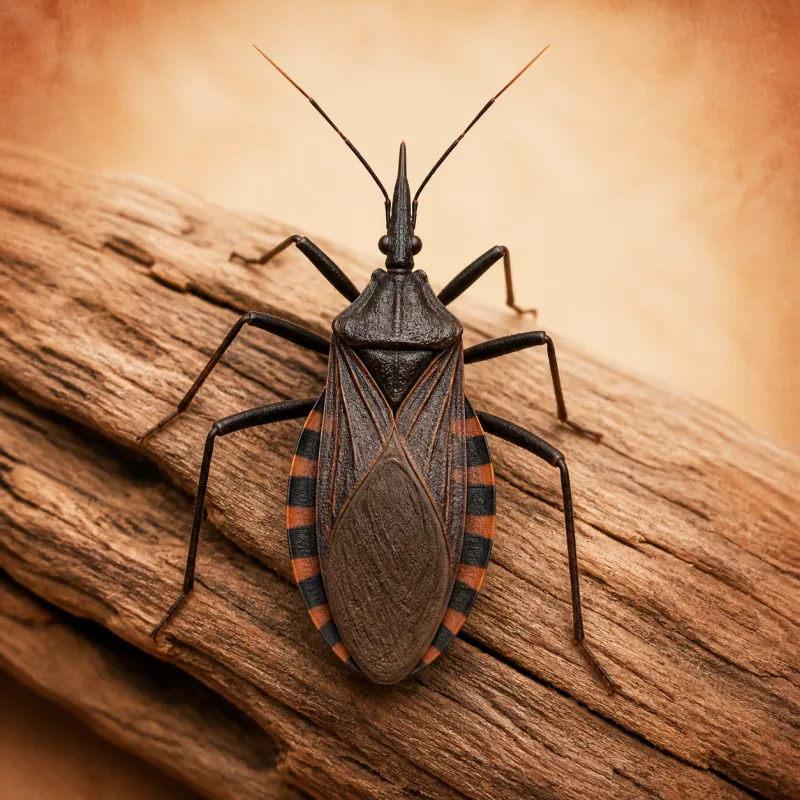
You usually cannot tell from the bite alone, so find the insect. A kissing bug is half an inch to just over an inch long with a cone-shaped head and thin straight legs. A bed bug is flat, reddish brown and about the size of an apple seed. If bites keep appearing and no kissing bug turns up, ask a provider about bed bugs.
Should I get tested for Chagas disease after a kissing bug bite?
Not on the bite alone. The University of Arizona Cooperative Extension says a kissing bug bite or a bug found at home does not by itself call for a Chagas test, because local transmission is very rare. See your doctor if fever, fatigue, a swollen eyelid or a hard red lump at the bite shows up in the following weeks, and bring the bug if you kept it.