
Black widows in Tucson: where they live and why they come first
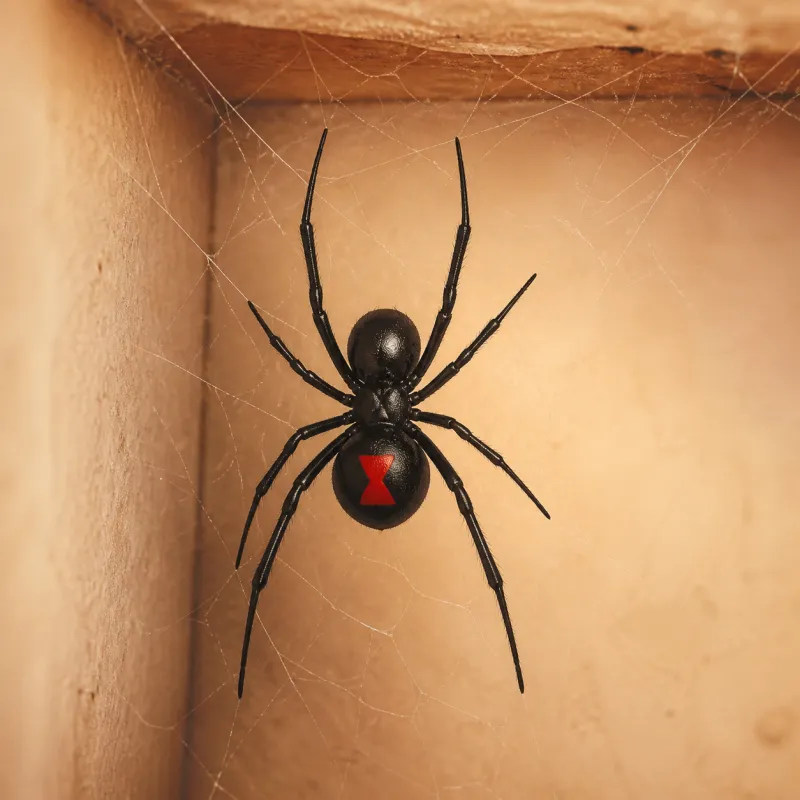
The western black widow, Latrodectus hesperus, is the spider Tucson providers get called about most, and it is the one worth taking seriously. The female is a quarter to three-quarters of an inch in the body, glossy black, with a red-orange hourglass on the underside of a round abdomen. She hangs upside down in a messy, surprisingly strong web built low to the ground in a dark, protected spot. The male is less than half her size, brown with cream markings, and not the problem.
Around a Tucson house, that dark protected spot is predictable. Garages, especially the floor perimeter and behind stored boxes. The hollow cores and weep holes of block walls. Under patio tables and chairs, inside pool equipment boxes and water meter boxes, in woodpiles, in the gap behind a hose reel. The Arizona-Sonora Desert Museum lists garages, lawn furniture and woodpiles as classic widow real estate, and anyone who has reached under a patio chair to fold it in October knows why. One female lays several egg sacs over her life, each holding on the order of 300 eggs, so a garage with a dozen webs in September started with one spider in spring.
Widows are shy and nocturnal. Bites almost always happen when a hand goes somewhere it cannot see: a glove left in the garage, a stack of pavers, the underside of a grill cover. Keep that in mind and you have prevented most bites already.
Black widow bite symptoms and when to get medical care
A black widow bite often starts as a pinprick and turns into cramping an hour later. The Arizona Poison and Drug Information Center, the poison center that covers Tucson and Pima County, describes pain, cramping and stiffness that can appear in the shoulders, back, chest or abdomen, along with nausea, vomiting, headache, anxiety and high blood pressure. Adults usually get through it in a day or two with treatment. Deaths are rare, and an antivenom exists for severe cases.
If you think you were bitten: wash the bite with soap and water, put a cool compress on it, keep the limb around heart level, and call Poison Control at 1-800-222-1222. In Tucson that reaches the Arizona Poison and Drug Information Center at the University of Arizona College of Pharmacy (the Banner Poison and Drug Information Center handles Maricopa County). Go straight to an emergency room if the person is a small child or elderly, or is having chest pain, severe abdominal cramping or trouble breathing. Bring the spider in a jar if you can do it without a second bite.
Are there brown recluse spiders in Tucson? The honest answer
The brown recluse, Loxosceles reclusa, is not established in Arizona. The University of Arizona Cooperative Extension says there are no established populations of brown recluse spiders in the state, and the Arizona Poison and Drug Information Center places that species in the Midwest. Most "brown recluse bites" diagnosed in Tucson turn out to be infections, other bites or something else entirely.
What Tucson does have is the brown recluse's desert relatives. The Arizona brown spider, Loxosceles arizonica, is native and fairly abundant in southern Arizona, and the desert recluse, Loxosceles deserta, lives in the western half of the state. Both are tan, about a third of an inch in the body, with six eyes in three pairs instead of the usual eight and a faint violin on the back. Both prefer desert debris, pack rat nests and the outskirts of town to a tidy urban garage, which is why Foothills and Vail homes backing onto open desert meet them more often than midtown does. Their venom works like their famous cousin's: little pain at first, then a slow, sometimes blistering wound over hours to days. The poison center's line is that medical treatment is always advised when a brown spider bite is suspected, so do not wait that one out.
If you have a pack rat nest against the house, you may have recluse relatives too. It is one more reason pack rat control and spider control tend to get done together here.
Wolf spiders, tarantulas and the ones you can leave alone
Most of the big spiders that make Tucson newcomers yelp are harmless, and several of them are on your side. The desert blonde tarantula, Aphonopelma chalcodes, is the hairy one crossing your driveway in August; those are males wandering to find females during the monsoon, as the Arizona-Sonora Desert Museum notes, and a bite is comparable to a bee sting and almost never happens. Wolf spiders are the fast brown hunters that sprint across the garage floor, build no webs, and eat the crickets that feed scorpions. Jumping spiders and cellar spiders round out the usual suspects. None of them needs an exterminator.
| Spider | How to tell | Risk |
|---|---|---|
| Western black widow (female) | Glossy black, round abdomen, red hourglass underneath, hangs upside down in a messy low web | Medically significant bite; call Poison Control |
| Black widow (male or immature) | Tan or brown with cream or white stripes on the abdomen, smaller, often in the same web | Males rarely bite; immatures grow into the problem |
| Arizona brown spider (recluse relative) | Uniform tan, a third of an inch, six eyes, faint violin, in desert debris and pack rat nests | Bite can cause a slow wound; get it looked at |
| Wolf spider | Brown, hairy, fast, hunts on the ground, no web, the female carries her young on her back | Harmless; eats pests |
| Desert blonde tarantula | Large, tan and hairy, slow, seen crossing roads on monsoon evenings | Harmless; leave it alone |
| Jumping spider | Small, compact, big front eyes, moves in hops | Harmless |
How Tucson spider exterminators actually treat black widows
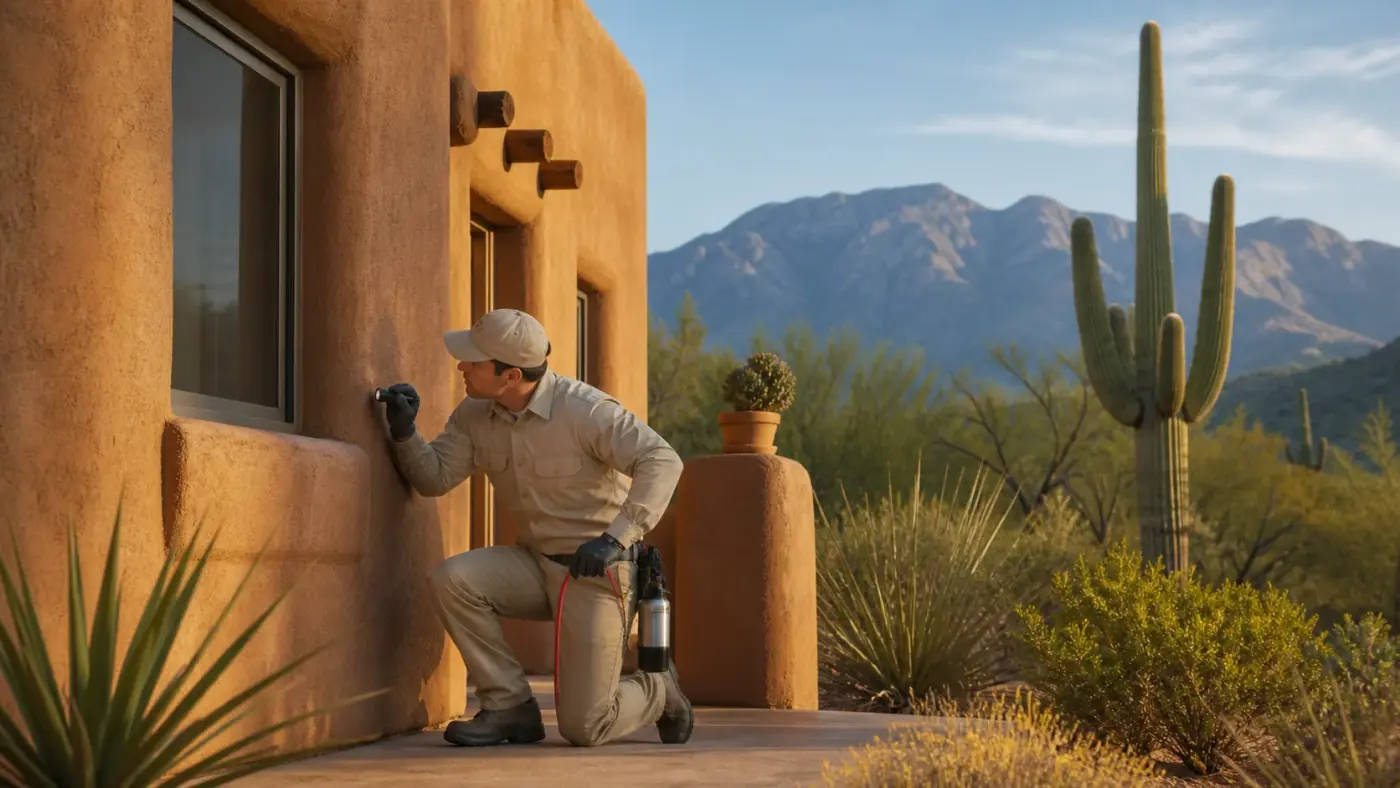
Good spider control is mostly physical work with targeted product behind it. Spiders walk on the tips of their legs and sit in webs rather than on treated surfaces, so a perimeter spray alone does less to a black widow than it does to an ant. A licensed local provider doing it right will usually:
- De-web the whole exterior with a pole brush: eaves, window frames, block walls, meter boxes, light fixtures, under patio furniture
- Remove egg sacs by hand, because a sac that hatches after the visit restarts the problem
- Treat harborage directly: block wall weep holes and voids, the garage perimeter, under stairs, behind stored items, pool equipment
- Apply an exterior perimeter treatment and dust the voids where widows sit
- Cut the food supply by treating crickets, roaches and other insects, and recommend yellow bulbs at entry lights
- Schedule a follow-up, since widows rebuild and new ones move in from the desert
On your side: keep the garage floor clear, store boxes on shelves off the floor, wear gloves when you move pavers or firewood, and shake out shoes and pool toys. Scorpions and widows use the same block wall voids, so a provider treating one is almost always treating the other; see scorpion control in Tucson if you have both.
Typical spider control cost in Tucson and what to check before you hire
These are typical market ranges across the Tucson metro, not a quote. The provider you are connected with sets the price after seeing the property.
- One-time black widow or spider treatment with de-webbing: roughly $100 to $300
- Spider control bundled into a general pest plan: roughly $100 to $300 for the initial visit, then roughly $35 to $75 per month or $90 to $165 per quarterly visit
- Block wall void and weep hole treatment: often included, sometimes an add-on on large properties
- Web removal on its own: usually part of the service, not billed separately
Before you hire, confirm the company and the applicator are licensed by the Arizona Department of Agriculture, Pest Management Division, which regulates every structural pest control business in the state. Ask whether de-webbing and egg sac removal are included, whether block walls get treated, and what the re-service policy is if webs come back in two weeks. The providers in our network are independent and licensed; when you call, you are routed by ZIP code to one that covers your address, from Oro Valley to Green Valley. For the rest of what lives in a Tucson yard, start at pest control in Tucson.
How the call works
- Tell us what you are seeing. Scorpions in the garage, mud tubes on the stem wall, a rat in the engine bay. A few details are enough.
- Get routed by ZIP code. Your call goes to an independent, licensed provider that actually covers your part of the Tucson metro.
- Book on the same call. Most providers can quote an inspection or treatment window right away.
Same-day or overnight service depends on which providers are taking calls in your part of Tucson, how many technicians are free and how busy the week is. Nobody can promise it, and capacity shifts from one neighborhood and one week to the next.
Frequently asked questions
Are black widows common in Tucson homes?
Yes, very. The western black widow is the most common medically significant spider in the Tucson metro, and nearly every garage, block wall and patio set hosts a few by late summer. They stay outdoors or in garages far more than in living spaces. Regular de-webbing, clearing clutter and a perimeter and harborage treatment keep the numbers down.
Are there brown recluse spiders in Tucson?
The true brown recluse is not established in Arizona, according to the University of Arizona Cooperative Extension. Tucson does have native relatives, the Arizona brown spider and the desert recluse, mostly in desert debris and pack rat nests at the edge of town. Their bites can cause a slow wound, so the Arizona Poison and Drug Information Center advises medical care for any suspected brown spider bite.
Will one spider treatment get rid of black widows?
One visit removes the webs, spiders and egg sacs that are there that day and leaves a residual in the harborage. It does not stop new widows walking in from the desert or a missed sac hatching, so most Tucson providers recommend a follow-up within a few weeks and then a regular plan through the warm months. Keeping the garage clear does as much as the product.
Should I worry about the tarantula walking across my driveway?
No. That is almost certainly a male desert blonde tarantula looking for a mate during monsoon season, which is when they wander. They are slow and docile, a bite is about as bad as a bee sting, and they will not set up house in your garage. Let it pass, keep the dog back, and save the call for black widows.