
What termite treatment costs in Tucson: the short answer
The cost of termite treatment in Tucson for most homes is $800 to $2,500, and the single biggest variable is the perimeter of your slab. National price guides put the average job around $750 with a typical range of $275 to $1,600, but Tucson skews higher than that average for a simple reason: nearly every home here is slab-on-grade with a garage, a patio and a block wall tied to the foundation, and all of those mean drilling. Treat those as typical Tucson-area ranges, not a quote. The licensed provider you are connected with prices the job after an inspection. If termites are only one line on your list, our guide to pest control cost in Tucson by service puts scorpion, rodent and bed bug pricing next to it.
One more Tucson-specific fact shapes every quote. The termite doing the damage is almost always the desert subterranean termite, Heterotermes aureus, which the University of Arizona Cooperative Extension calls the most destructive termite in Arizona and the most common subterranean termite in the Sonoran Desert below 4,000 feet. Subterranean means the fix goes in the soil, which is why Tucson pricing is about linear feet of foundation, not square feet of house. If a monsoon swarm is what sent you here, our guide to termite swarm season in Tucson explains what those flying insects say about your house before you start collecting quotes.
Cost by treatment method
Liquid soil treatment is the default in Tucson and usually the cheapest way to stop an active infestation. Bait systems cost more up front and carry an annual fee, and spot treatments are cheap but only make sense when the inspection finds one isolated point of entry.
| Method | Typical Tucson range | Pricing basis | Ongoing cost |
|---|---|---|---|
| Liquid soil treatment (non-repellent termiticide) | $800 to $2,500 | $5 to $15 per linear foot of foundation, more with heavy drilling | Optional annual renewal, $150 to $350 |
| Bait station system | $1,200 to $3,000 install | Stations around the perimeter, roughly every 10 to 15 feet | Annual monitoring, $200 to $450 |
| Spot or localized treatment | $250 to $700 | Per tube location or wall void, foam or liquid | Usually no warranty on the rest of the house |
| Tent fumigation | $2,000 to $8,000 | $1 to $4 per square foot | None; no residual protection |
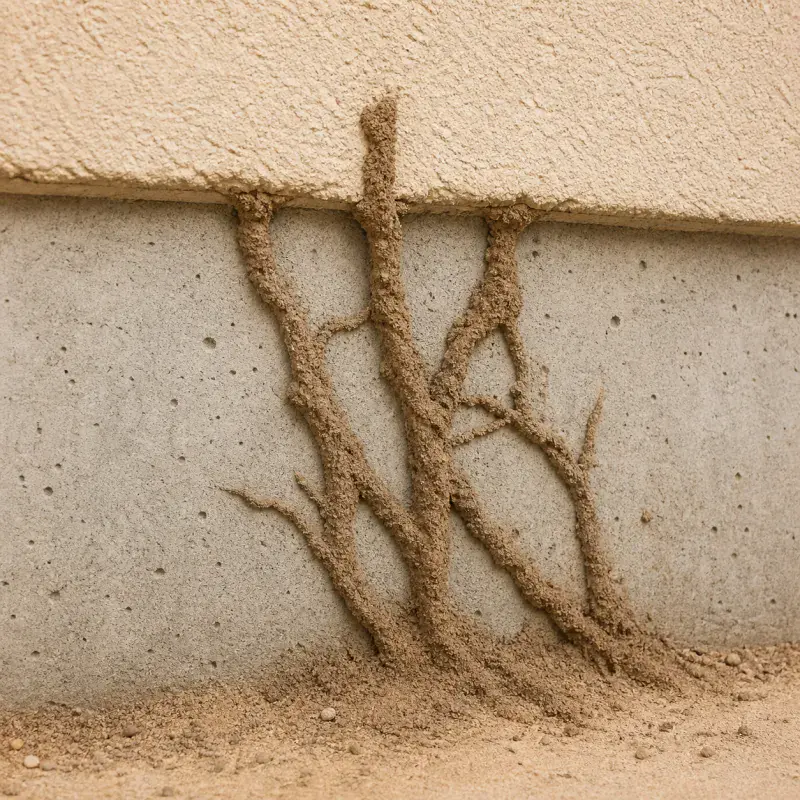
A note on fumigation, because buyers from California ask. Tenting is a drywood termite treatment. Tucson does have a drywood species, the light western drywood termite, which the University of Arizona Cooperative Extension lists as a significant pest at Phoenix-to-Tucson elevations, but the large majority of Tucson termite work is subterranean, and subterranean colonies are not treated by fumigation because they live in the ground, not the wood. If a quote for mud tubes on your stem wall includes a tent, get a second opinion.
Cost by home size: why Tucson quotes are in linear feet
Tucson termite quotes are priced by the linear footage of the foundation perimeter, so a sprawling single-story ranch costs more to treat than a two-story home with the same square footage. The table below uses $6 to $12 per linear foot, the middle of the published range for liquid treatment, and assumes a typical slab home with an attached garage on the same slab.
| Home (approximate footprint) | Foundation perimeter | Typical liquid treatment range |
|---|---|---|
| 1,200 sq ft single-story | About 140 linear feet | $850 to $1,700 |
| 1,800 sq ft single-story | About 170 to 180 linear feet | $1,050 to $2,150 |
| 2,500 sq ft single-story | About 200 to 220 linear feet | $1,200 to $2,650 |
| 2,500 sq ft two-story | About 150 linear feet | $900 to $1,800 |
| 3,500 sq ft foothills home with casita | 260 linear feet and up | $1,600 to $3,100 and up |
Measure it yourself before you call. Walk the outside of the house and pace off the perimeter, then add the garage if it shares the slab. If a quote's footage is wildly different from your number, ask why. Sometimes there is a good reason (a patio slab that has to be treated as part of the foundation), and sometimes there is not.
What pushes a Tucson termite quote up
Drilling is the number one cost driver. Everywhere concrete meets the foundation, the technician has to drill holes along the joint, inject termiticide under the slab, then patch. Tucson homes pile up concrete fast: garage slab, covered patio, pool deck, pavers, a front courtyard. Each run adds labor, product and patching time.
- Garage and patio slabs: the most common add-on, drilling along the expansion joint where the slab meets the stem wall
- Pool decks and pavers: pavers have to be lifted or drilled through, and pool plumbing limits where a trench can go
- Additions and casitas: every added slab creates a new cold joint, and cold joints are termite highways
- Post-tension slabs: common in newer Arizona subdivisions; drilling has to avoid the cables, which slows the work
- Interior activity: tubes in a bathroom wall or under tile mean interior drilling or foam on top of the exterior perimeter
- Block walls tied to the house: the wall footing can bridge the barrier and has to be treated too
- Access: a foundation buried under river rock, decking or dense landscaping takes longer to trench
None of these are padding. They are real hours. The padding shows up when a quote charges for all of them without anyone having measured anything, which is covered in the red flags below.
Warranty and renewal economics: what the annual fee buys
The warranty, not the treatment, is what you are really shopping for in Tucson, because desert subterranean termites stay active most of the year and a treated home can be attacked again. Arizona law sets a floor only for pre-construction work: under Arizona Administrative Code R3-8-309, a business that pretreats a new home must retreat at no cost if subterranean termites show up within three years. For the post-construction treatment most homeowners buy, the warranty is a private contract, and the Arizona Department of Agriculture is clear that state law does not require a long-term warranty or dictate damage repair. Read the paper.
The typical structure is a one-year warranty included with treatment, renewable each year for $150 to $350. Over five years that is $750 to $1,750 on top of the treatment, which is real money, so think it through. A renewal usually buys an annual inspection plus free retreatment if termites return. It almost never pays to repair damaged wood unless the contract says "repair" or "damage" in writing. If your home sits in a subdivision where neighbors are treated every year, the renewal is cheap insurance. If the treatment was a full non-repellent perimeter on a simple slab and you are willing to check the stem walls yourself each spring, some homeowners let it lapse after year two or three. Make sure the warranty transfers to a buyer; in a Tucson sale, a transferable termite warranty is a selling point, and many lapse simply because the new owner never registers it.
Termite inspection cost in Tucson and when it is free
A termite inspection in Tucson is usually free when you are a homeowner asking about a possible problem, because the provider is hoping to sell the treatment. It is not free when someone else needs the paper: a Wood Destroying Insect Inspection Report for a home sale typically costs $75 to $110 in the Tucson area, and only a licensed Arizona business can complete and sign one. Lenders frequently require it before closing.
Two Arizona-specific points worth knowing. First, when a licensed business treats a home, it must file a Termite Action Report Form with the Arizona Department of Agriculture, Pest Management Division within 30 days, and the Department keeps a searchable public database of those reports by address. Before you buy in Tucson, look the property up; the termite history of the house is a matter of public record. Second, a free inspection is a sales visit. That is fine, and most are honest, but it means the inspector has a reason to find something. If a free inspection turns up a big number, a paid second inspection from a different licensed company is the best $100 you will spend this year. Knowing what happens during a termite inspection in Tucson makes it a lot easier to tell a thorough visit from a quick lap around the house.
How to compare two termite quotes (and the red flags)
Two Tucson termite quotes can be $1,000 apart and both be honest, because they may be pricing different jobs. Line them up on these points before you look at the total:
- Linear footage treated, and whether it matches your own measurement
- Method and product: a named non-repellent termiticide for liquid work, or the bait brand and station count
- Drilling included: garage, patio, pool deck, interior slabs, block wall footings
- Warranty term, renewal price, what it covers, and whether it transfers
- Whether the Termite Action Report will be filed
- Business license number from the Arizona Department of Agriculture
Red flags: a quote written in the driveway without tracing the tubes or measuring the slab; pressure to sign today for a "discount"; a tent fumigation for mud tubes on a stem wall; a price per square foot of living space instead of per linear foot; no license number on the paperwork; a warranty that only covers "retreatment at our discretion."
When you call, you are routed to a licensed local provider by ZIP code. Get the inspection, get it in writing, and compare it against the ranges on this page. For how the treatment itself works, read our Tucson termite control page, and if the winged insects on the window sill turned out to be ants, our ant control page covers that.
Frequently asked questions
Why is termite treatment in Tucson more expensive than the national average?
Drilling. National averages lean on homes with crawl spaces or basements, where trenching is simple. Tucson homes are slab-on-grade with attached garages, patios, pool decks and block walls tied to the foundation, and every one of those joints has to be drilled and injected. Add long single-story perimeters on big desert lots and the linear footage climbs fast.
Is the annual termite warranty renewal worth it in Tucson?
Usually yes for the first few years, because desert subterranean termites stay active most of the year and a renewal buys an inspection plus free retreatment. It is not worth much if the contract excludes repair and you are disciplined about checking stem walls yourself. Read what it covers, confirm it transfers to a buyer, and compare the renewal price to the cost of a fresh treatment.
How much is a termite inspection in Tucson?
A homeowner inspection is often free because the provider hopes to sell the treatment. A Wood Destroying Insect Inspection Report for a real estate transaction typically costs $75 to $110 in the Tucson area and must be completed by a licensed Arizona business. If a free inspection produces a large quote, a paid second opinion from another licensed company is worth the fee.