
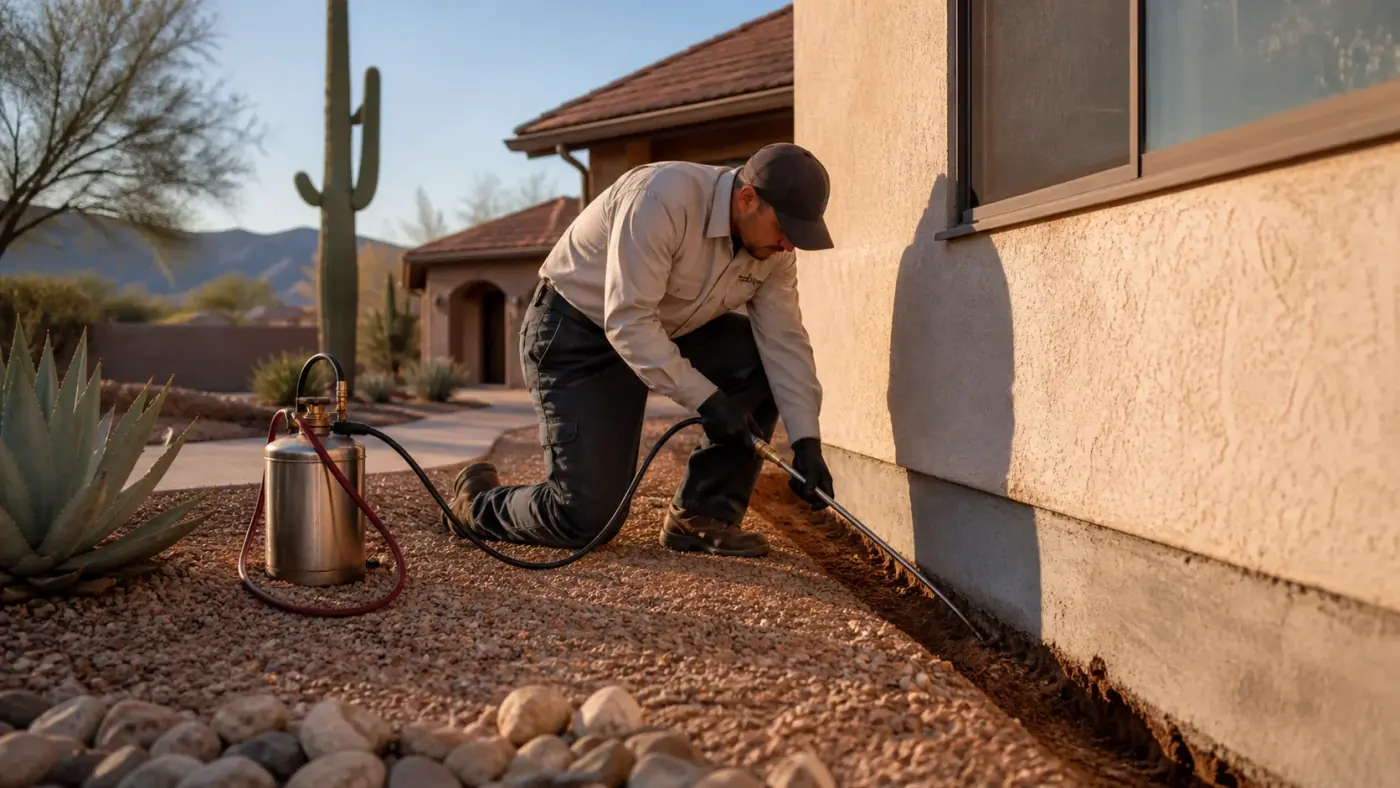
What a Tucson termite inspection actually is
A termite inspection is a visual search and a probing of wood, not an X-ray of your walls. The University of Arizona Cooperative Extension publication Arizona Termites of Economic Importance (AZ1369, Baker and Marchosky) says the primary method of inspection is visual searching or probing of wood, and that the "boots on the ground" visual inspection remains the industry standard because acoustic detectors, moisture sensors, infrared and detection dogs all cost more and carry their own drawbacks. Dogs do find termites that visual inspection misses, the same publication notes, but certifying a dog and a handler is expensive. So a routine Tucson house call is a human with a flashlight.
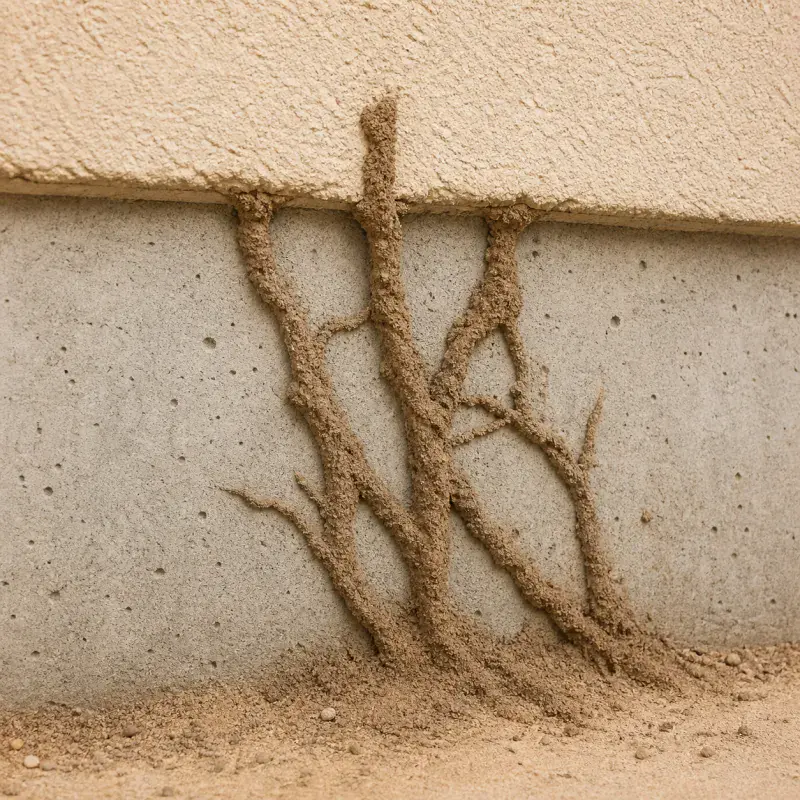
The value is not equipment. It is knowing where to point the light, and what a pale, nearly airtight, round-sided mud tube means next to a flat dirty brown one. AZ1369 draws that line: the desert subterranean termite builds small, strong, nearly airtight tubes with a circular cross section, plastered pale with fecal material, while the arid-land subterranean termite builds flatter, looser, dark brown ones. Same wall, two different conversations.
What skipping the inspection costs a Tucson house
Skipping a termite inspection in Tucson costs you the one thing that is genuinely scarce here, which is early warning. Picture the back bedroom. Dead-quiet night in May, the AC kicks off, the cooling stucco starts ticking. Eighteen inches from your pillow, on the far side of the drywall, a column of pale workers is climbing a pencil-width tube built over your stem wall in a spot nobody has looked at since the house was framed. They are eating the bottom plate the wall stands on, from the inside out, leaving a painted shell that looks perfect. No smell. No sound. Nothing on your side of the paint but a faint wave near the closet door that you blamed on the swamp cooler two summers ago.
The desert subterranean termite, Heterotermes aureus, is not a rot specialist waiting on water damage. AZ1369 calls it a generalist feeder on dead wood of every kind, from cactus ribs and desert hackberry to structural timbers in floors and rafters, and identifies infested structures by drop tubes hanging from a ceiling and mud shelter tubes built over stem walls. Those tubes are the only announcement you get.
Then one Saturday you pull the holiday bins down and there it is: a pencil-thin stalactite of dried mud off the garage ceiling. Or a screwdriver goes into a door jamb like the wood is a cracker. Or the worst version, a buyer's inspector finds it while your house is in escrow, and the treatment plus the carpentry lands on your side of the table at the exact moment you have no leverage.
The honest counterweight comes from the same University of Arizona work: Arizona termites generally take a long time to become established, and severe structural damage can be avoided by prompt remedial control. The house is not coming down next month. You have runway. An inspection is how you find out you are standing on it.
Where the inspector looks, and what each spot tells them
A Tucson termite inspection follows the termite's route, which means it starts outside at the soil line and works inward. The University of Arizona homeowner guide Termite Management for Homeowners (AZ1356) tells homeowners to examine the foundation wall at the soil line, cracks in concrete floors, and the places where pipes and ducts come up through the slab, and that is exactly the order a good inspector works in. Expect the visit to look like this.
| Where | What they are looking for | What it tells them |
|---|---|---|
| Exterior stem wall, all the way around | Mud shelter tubes, stucco running below grade, soil piled over the foundation | The main entry route, and whether you have left them cover |
| Garage walls, ceiling and floor cracks | Drop tubes, tubes behind stored boxes, activity at the slab joint | Garages are where Tucson infestations are found most often |
| Slab penetrations and expansion joints | Tubes at plumbing and duct chases, cracks in concrete floors | A hairline crack is a highway under the house |
| Baseboards, door frames, window sills | Hollow sound when tapped, blistered paint, discarded wings | Galleries inside wood you can reach |
| Attic, crawl space, patio, additions | Access where it exists, timbers and roof framing | Additions often sit on their own untreated slab |
| Irrigation, grade and landscaping | Drip emitters against the house, water pooling at the wall, wood touching soil | Conducive conditions, which get written into the report |
Two practical notes before the visit. Clear a path along the garage wall and around the water heater, because anything the inspector cannot see gets written down as not inspected. And if you swept up swarmers after a monsoon storm, keep a few: AZ1356 recommends collecting live specimens in alcohol for identification, and the species drives everything that happens next.
The report, and what the state does with it
A Tucson termite inspection ends in paperwork that outlives the visit, and Arizona takes that paperwork seriously. For a real estate transaction the document is the Wood-Destroying Insect Inspection Report, the WDIIR. The Arizona Department of Agriculture publishes the official form and limits who may complete it to a certified applicator holding the wood-destroying organism inspection or treatment certification. The form records visible evidence of wood-destroying insects, damage found, conditions conducive to infestation, the areas inspected and not inspected with the limits of the inspection, and any recommended treatment.
It does not stop at your kitchen table. Under Arizona's pest management rules the licensed business must file a termite action report form with the Pest Management Division within 30 calendar days of a pretreatment, a new-construction or final grade treatment, an initial corrective treatment or a WDIIR, and those filings go into a database the public can search by address. That cuts both ways, and both ways are useful: you can look up what was done to your house before you bought it, and a future buyer can look up what was done while you owned it.
Read this line on your report first: areas not inspected. Boxes stacked against a wall, a locked casita, a sealed attic. That list is the honest map of what nobody actually saw, and it is where unpleasant surprises live.
What it costs and when to book one
A termite inspection in Tucson is often free when you are the homeowner asking about something you found, because the provider is hoping to sell the treatment. You pay when someone else needs the paper: a Wood-Destroying Insect Inspection Report for a home sale typically runs about $75 to $110 in the Tucson area, and a paid standalone inspection outside a sale sits in the same neighborhood, roughly $75 to $150. Those are typical market ranges, not a quote, since the licensed provider sets their own pricing. Our Tucson termite treatment cost guide covers what comes after, if the inspection turns something up.
Timing has an actual answer. AZ1356 tells Tucson homeowners to inspect the stem wall about twice a year, once in spring, especially after a wet winter, and again near the end of monsoon season when termites are most active. AZ1369 adds that a pest management professional doing an annual inspection is the better version of that habit. And if your house is more than about five years old, the same guide warns that the builder's final grade termiticide treatment has likely degraded, which is a good reason to stop assuming the slab is still protected.

How to inspect your own house first
You can run a decent first-pass termite inspection on your own Tucson house in about forty minutes with a flashlight and a screwdriver, and the University of Arizona guidance is specific enough to follow line by line. Do it before you call anyone. Worst case, you learn your own foundation.
- Walk the whole stem wall, that band of foundation between soil and stucco, looking for pencil-width mud tubes. Slow down behind the shrubs and at the back of the house, where nobody ever looks.
- Do the garage properly: walls, ceiling, slab joint, and behind whatever is stacked against the wall. AZ1369 specifically lists mud tubes in storage areas.
- Check where pipes and ducts come up through the slab and any crack in a concrete floor, which AZ1356 names as entry points.
- Tap baseboards, door frames and window sills every few inches with a screwdriver. Hollow sound, or the tip punching through, means galleries.
- Look for piles of discarded wings near lights and windows, and pellets or sawdust that keep reappearing after you sweep.
- Break a one-inch gap out of any tube, mark the spot, look again in a few days. Rebuilt tube, active colony.
Then take away what the colony wants, which is damp soil and hidden cover against your foundation. AZ1356 is precise about it: keep about four inches of bare stem wall between the soil line and the stucco so tubes stay visible, slope water away from the house, keep the first foot along the wall dry, plant shrubs and trees at least 18 inches out, keep main irrigation lines more than 18 inches away, and avoid digging along the stem wall, since that soil holds any existing treated barrier. Two local habits undo all of it: the drip emitter tucked against the stucco and the decorative rock bed mounded over the stem wall. Pull both back. And if the wings on your window sill came from a monsoon flight rather than a wall, our guide to termite swarm season in Tucson sorts out which insect you are holding.
When DIY is not enough
Your own inspection stops being enough the moment you find evidence, because confirming the species and mapping a colony under a slab is licensed work with licensed products. AZ1356 describes the standard subterranean treatment as a six-inch trench dug around the structure plus down-drilling through concrete that butts against the house, applied at the full label rates Arizona law requires. Not a weekend project. These are the signs you have crossed the line:
- Any mud tube on the stem wall, or a drop tube hanging from a garage or interior ceiling
- A tube that rebuilds itself after you break it open
- Wood that sounds hollow, or a screwdriver that sinks into a door frame or baseboard
- Swarmers or piles of wings inside the house, especially clustered at one window or one room
- A house older than about five years with no treatment on record, or a sale where a WDIIR is coming either way
If one of those fits, the sensible next step is a licensed set of eyes, not another lap with the flashlight. Call (888) 217-8578 and we connect you with a licensed local provider covering your ZIP code, from midtown out to Oro Valley and Marana. They will confirm the species, map every tube, tell you plainly whether you are looking at a spot treatment or a full perimeter job, and file the state paperwork that follows. Our termite control in Tucson page explains how those treatments work before anyone walks your foundation.
And take a breath. Finding a tube on your stem wall in Tucson puts you in extremely ordinary company, somewhere between everyone with a saguaro in the yard and everyone who has lost a patio umbrella to a haboob. Houses here sit on ground with termites nearby and stay sound for decades, because somebody looked twice a year, found it early and got the soil treated. You just did the looking part.
How the call works
- Tell us what you are seeing. Scorpions in the garage, mud tubes on the stem wall, a rat in the engine bay. A few details are enough.
- Get routed by ZIP code. Your call goes to an independent, licensed provider that actually covers your part of the Tucson metro.
- Book on the same call. Most providers can quote an inspection or treatment window right away.
Same-day or overnight service depends on which providers are taking calls in your part of Tucson, how many technicians are free and how busy the week is. Nobody can promise it, and capacity shifts from one neighborhood and one week to the next.
Frequently asked questions
How long does a termite inspection take in Tucson?
It depends on the house, and the provider sets the schedule, so ask when you book. What stretches a visit is perimeter footage, an attached garage plus a casita or a workshop, added rooms with their own slabs, and an attic or crawl space the inspector has to get into. A compact slab home with a clear stem wall is a much shorter job than a rambling foothills property with three additions and a wall of stored boxes in the garage.
Do I need a termite inspection to sell a house in Arizona?
That is a question for your lender and your purchase contract, not for a pest company. What the state does control is the paperwork: the Arizona Department of Agriculture publishes the official Wood-Destroying Insect Inspection Report form, limits who may complete it to a certified applicator in the wood-destroying organism inspection or treatment category, and requires the business to file a termite action report form with the Pest Management Division within 30 calendar days. Ask your lender early, because scheduling around escrow is where people get squeezed.
How much does a termite inspection cost in Tucson?
Often nothing, if you are the homeowner calling about something you found, because that visit is a sales call for the treatment. You pay when someone else needs the paper: a Wood-Destroying Insect Inspection Report for a home sale typically runs about $75 to $110 in the Tucson area, and a paid standalone inspection outside a sale is roughly $75 to $150. Treat those as typical Tucson-area ranges, not a quote. The licensed provider sets the actual price.
Can I check whether my house was ever treated for termites?
Yes. The Arizona Department of Agriculture keeps the termite action report forms filed by licensed businesses in a database that the public can search by property address, so you can see prior treatments and inspection reports on record for your house. One caveat worth repeating: an empty result does not mean the house is termite free. It means nothing was filed with the state, which is a different thing entirely.