

Why every wild bee colony in Tucson is treated as Africanized
Every wild honey bee colony in Tucson gets treated as Africanized, because the University of Arizona Cooperative Extension states that all wild honey bees in Arizona are Africanized to some extent. The bees match European honey bees in size and color, and the Arizona Poison and Drug Information Center treats the sting like any other bee sting. The difference is behavior.
The Cooperative Extension describes a larger alarm zone around the hive, defended in larger numbers and more rapidly, with bees chasing intruders over longer distances. A European colony sends a dozen guards after the mower; an Africanized one sends hundreds, and they follow you down the street.
Where bees nest in Tucson homes
Bees in Tucson nest in any dry, dark void with a dime-sized entrance. The Cooperative Extension lists hollow block walls, buildings and irrigation boxes alongside tree hollows and rock crevices. Around Tucson homes that means:
- Hollow cells of a block fence, entered through a missing cap or weep gap
- Water meter boxes by the sidewalk and irrigation valve boxes in the gravel
- Eaves and soffits where a fascia board has pulled away from the stucco
- Attics, sheds, grills and the truck that has not started since 2019
The tell is traffic: a steady line of bees in and out of one spot, all day. A stream into the block wall is a colony, and by the time you hear it through the drywall, there is comb inside.
Swarm or established colony: what you see and what to do
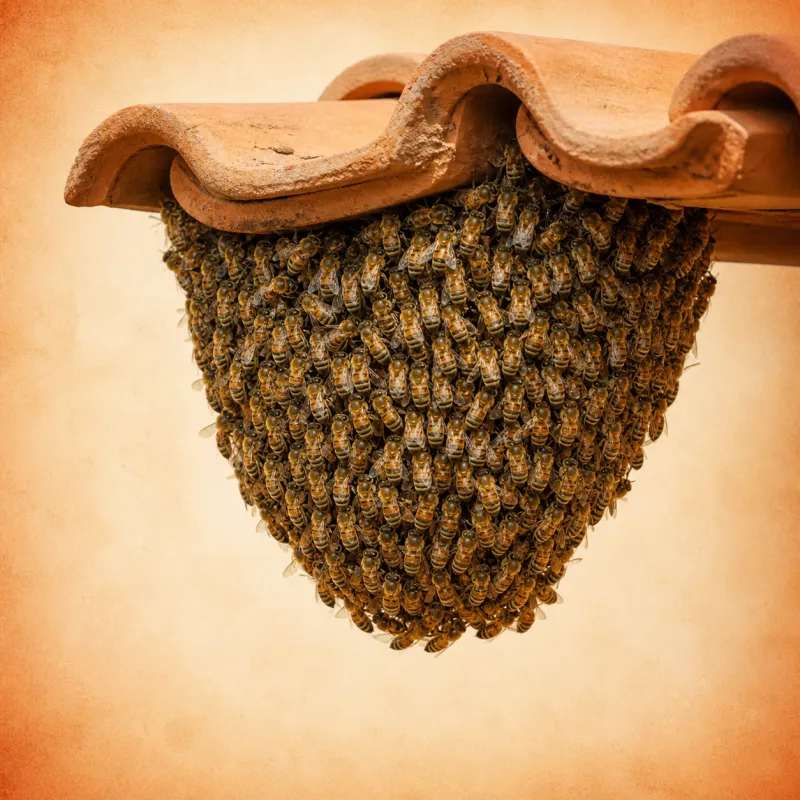
A swarm is a homeless colony resting with no comb; an established colony has brood and honey to defend, and danger and price both follow that difference. Southern Arizona beekeepers put swarm season at roughly March 1 through June 15.
| Question | Swarm | Established colony |
|---|---|---|
| What you see | A football-sized ball of bees on a branch or eave, arrived within hours, fairly calm | Steady traffic into one hole in a wall, box or roofline for weeks, often with a hum |
| Danger | Lowest; no brood to protect | Highest, and growing with the comb |
| What to do | Keep kids and dogs inside, do not hose it, and call; many leave in a day or two, often for a neighbor's wall | Do not plug the hole or spray it; call for removal with the comb taken out |
If the cluster only showed up this morning, our guide to what to do when you find an Africanized bee swarm in Tucson walks through the first hour, from getting the dog inside to telling whether the bees are leaving or moving in.
What to do if bees attack
If bees attack, run. Run in a straight line to the nearest house or car, get inside, and shut the door. Cover your face with your shirt as you go. The Cooperative Extension says to keep going at least 240 yards and never to dive into a pool: the bees hover over the water and wait. Once safe, scrape the stingers out within seconds; the Arizona Poison and Drug Information Center notes the venom sac keeps pumping after the bee is gone.
When to get medical care: call 911 for trouble breathing, face or throat swelling, spreading hives, dizziness or collapse, and for anyone stung dozens of times, especially a child, an older adult or someone with heart or lung problems. For anything less, call the Arizona Poison and Drug Information Center in Tucson, 1-800-222-1222, around the clock.
Live removal vs extermination, and why the comb has to come out
Most established colonies inside Tucson walls end up exterminated rather than relocated; Africanized temperament is not something a beekeeper wants in a managed hive, and calm spring swarms are the exception that can sometimes be boxed alive. Either way, the Cooperative Extension says bees and comb should be removed by professionals with protective equipment, and killing the bees is the easy half.
The comb is the hard half. Leave it in the wall and Tucson heat melts the wax, honey soaks the drywall, and ants, roaches and pack rats come for the sugar. Old comb also smells like home to next spring's swarm. A complete job opens the wall, cuts out the comb, seals the entrance and patches the stucco. DIY fails for the same reasons: wasp spray enrages the thousands you cannot see, and foam in the entrance pushes the colony indoors through outlets and can lights.
Typical bee removal cost in Tucson
Bee removal in Tucson typically runs from about $100 for a reachable swarm to $1,200 or more for a wall cutout, based on published Tucson price guides. These are typical market ranges, not a quote; the provider you are connected with sets the price on site.
| Job | Typical Tucson range |
|---|---|
| Swarm pickup from a tree or yard | Roughly $100 to $300 |
| Accessible colony in a shed, eave, meter box or open block wall | Roughly $250 to $500 |
| Structural cutout in a wall, roof or chimney with comb removal | Roughly $600 to $1,200 and up |
If a pesticide is used, the business applying it must be licensed by the Arizona Department of Agriculture, Pest Management Division; ask for the number and whether comb removal and sealing are included. Our network covers Tucson and its suburbs, and the valve box that hosts bees in May breeds mosquitoes in July.
How the call works
- Tell us what you are seeing. Scorpions in the garage, mud tubes on the stem wall, a rat in the engine bay. A few details are enough.
- Get routed by ZIP code. Your call goes to an independent, licensed provider that actually covers your part of the Tucson metro.
- Book on the same call. Most providers can quote an inspection or treatment window right away.
Same-day or overnight service depends on which providers are taking calls in your part of Tucson, how many technicians are free and how busy the week is. Nobody can promise it, and capacity shifts from one neighborhood and one week to the next.
Frequently asked questions
Are the bees in my Tucson yard Africanized?
Assume yes. The University of Arizona Cooperative Extension says all wild honey bees in Arizona are Africanized to some extent, and you cannot tell by looking, since they match European honey bees in size and color. Treat any wild colony in Tucson as defensive and keep people and pets away.
Will a bee swarm in my tree leave on its own?
Often, yes. A swarm is a homeless colony resting while scouts hunt for a cavity, and many move on within a day or two. The catch is where they go next, often a block wall, valve box or eave nearby. A calm cluster is the cheapest, safest moment to call.
Can I just seal the hole where bees are going into my wall?
No. Sealing the entrance traps a live colony in the wall, and the bees look for another way out, usually into the house through an outlet or can light. It also leaves the comb to melt and draw ants and rodents. Have a provider remove bees and comb first, then seal.
Do Tucson bee removal providers relocate the bees or kill them?
Calm spring swarms are sometimes collected alive for a beekeeper. Established Africanized colonies inside structures are usually exterminated, because their temperament is wrong for managed hives and live removal from a wall is slow and risky. Ask which approach the provider proposes and whether comb removal is included.