
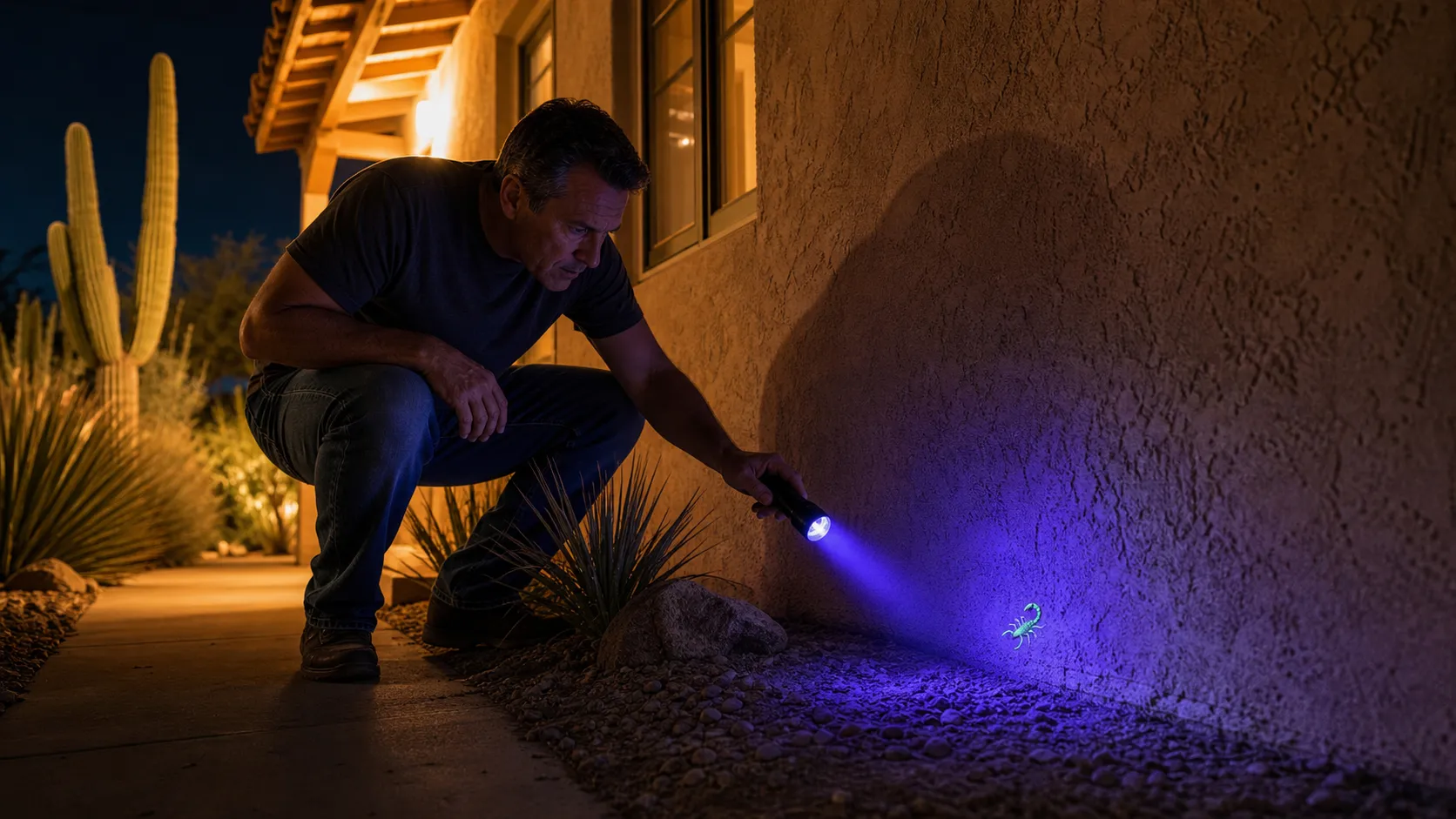
Why Tucson is bark scorpion country
The Arizona bark scorpion, Centruroides sculpturatus, is the most venomous scorpion in North America, and Tucson sits in the middle of its Sonoran Desert range. Arizona has more than 30 scorpion species, but the Arizona Poison and Drug Information Center calls the bark scorpion the only potentially dangerous one in the state. The other two you meet here, the giant desert hairy scorpion and the stripe-tailed scorpion, look scarier and hurt less.
What turns it from a desert animal into a house problem is behavior. The bark scorpion is slender, straw-colored, 2 to 3 inches long, and the University of Arizona Cooperative Extension describes it as a proficient climber that walks up textured walls and across ceilings. It squeezes under doors and through gaps about the thickness of a credit card. It adores hollow block walls: in University of Arizona research, 95 percent of bark scorpions chose block wall voids over every other refuge around buildings and landscapes. Look around your yard. Now count the block walls.
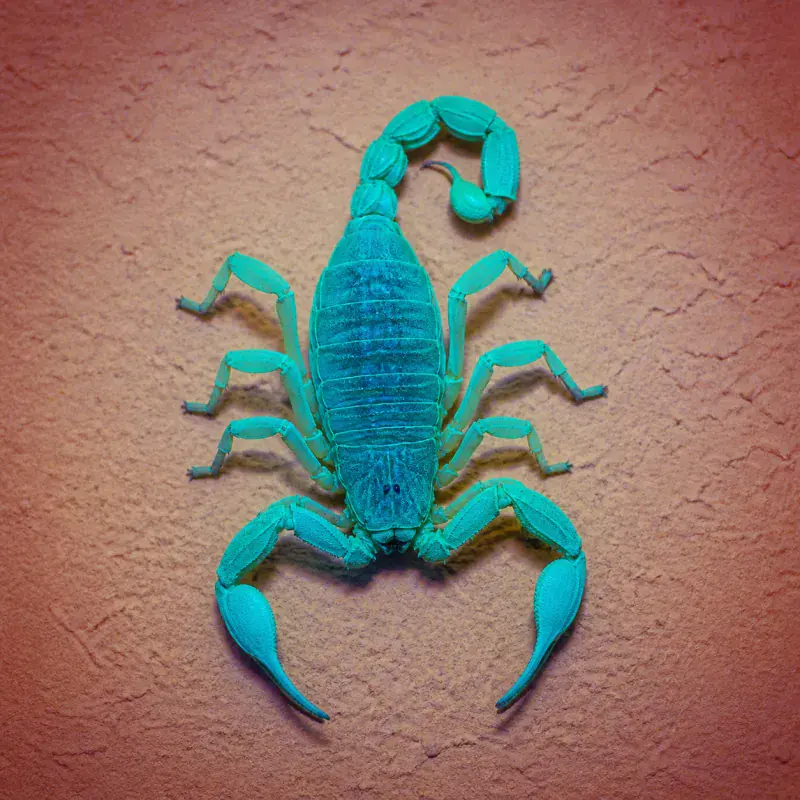
It falls into bathtubs and sinks and cannot climb back out on slick porcelain, which is why you meet it at 6 a.m. Females give live birth to roughly 25 to 35 young that ride on the mother's back for one to three weeks, so one scorpion wearing a backpack of babies means a breeding population. And every one of them glows blue-green under ultraviolet light, which is the one break Tucson homeowners get.
How to do a UV blacklight scorpion hunt
A UV flashlight hunt is the fastest way to learn whether you have a scorpion problem and where it lives. Scorpions fluoresce under ultraviolet light, as the University of Arizona Cooperative Extension notes, and an inexpensive blacklight turns a tan scorpion on a tan wall into a glowing target. Most bark scorpion movement happens between 7 and 11 p.m. and again from 3 a.m. to sunrise, so go out after full dark on a warm night.
- Walk the whole perimeter slowly: block walls, the base of the stucco, weep holes, hose bibs, the AC pad
- Check door and window frames, under the eaves and the garage door seal, since these are the entry points
- Sweep the pool equipment, woodpiles, stacked pavers, planters and anything leaning on a wall
- Inside, check closets, under sinks, behind the water heater and the garage perimeter
- Wear closed shoes, carry long tongs, never use your hand
Count what you find and note where they cluster. Five on the east block wall and none on the west tells a provider where to concentrate. More than a couple on the house itself, or any indoors, is when most Tucson homeowners pick up the phone.
What a bark scorpion sting feels like, and when to call Poison Control
A bark scorpion sting feels like a hot needle followed by electric tingling that refuses to stay put. Expect immediate burning pain with little or no swelling, then numbness and tingling that can travel up the limb or across the body. The University of Arizona Cooperative Extension notes that symptoms typically develop within 20 minutes and can keep worsening for the first 4 hours, so watch the person, not the clock. Emergency doctors use a "tap test": tapping the sting site makes the pain jump, and that reaction is close to diagnostic for this species.
| What you see | What to do |
|---|---|
| Local pain, tingling and numbness in a healthy adult | Soap and water, cool compress, over-the-counter pain reliever, and a call to Poison Control to confirm home care |
| Tingling spreading across the body, nausea, sweating | Call Poison Control now and be ready to drive to an emergency room |
| Roving or jerky eye movements, drooling, trouble swallowing, slurred speech, twitching, trouble breathing | Emergency room immediately; these are the signs antivenom treats |
| Any sting in a child under 6, an elderly person, or someone with heart or breathing problems | Call Poison Control right away, even if they look fine |
If you are reading this because someone was stung tonight, our guide to what to do in the first hour after a bark scorpion sting walks through the first aid, the symptoms that mean go to a hospital, and how to find the wall it came from.
Poison Control for Tucson: call 1-800-222-1222. In Tucson that reaches the Arizona Poison and Drug Information Center at the University of Arizona College of Pharmacy, which covers every Arizona county except Maricopa (Phoenix calls go to the Banner Poison and Drug Information Center). The Tucson center handles 900 to 1,500 scorpion sting calls a year and guides more than 84 percent of bark scorpion patients through recovery at home. An FDA-approved antivenom, tested in trials run through the University of Arizona, is available in Arizona hospitals for severe cases. Jerky body movements or wild eye movements in a stung child mean go now.
What professional scorpion control in Tucson actually involves
Real scorpion control is a harborage and entry-point job with some chemistry on top, not a guy with a sprayer walking the baseboards. The University of Arizona Cooperative Extension is blunt: scorpions are extremely difficult to eradicate and difficult to manage with pesticides alone. A bark scorpion walks on the tips of its legs, so it barely touches a treated surface, and it can go months without eating, so it will wait out a barrier inside a wall void. Sprays that flatten ants and roaches mostly annoy it.
A licensed local provider who does scorpion work well will usually:
- Inspect, often with a UV light at night, to map where the scorpions come from
- Treat the perimeter, the foundation line, under the eaves, around every door and window, and the garage
- Dust the hollow cores and weep holes of block walls, where the population actually lives
- Treat or remove harborage: woodpiles, stacked pavers, lumber, pots against the house, palm skirts
- Knock down the food supply, meaning crickets, cockroaches and whatever your porch light pulls in
- Recommend sealing, as part of the service or as a separate job
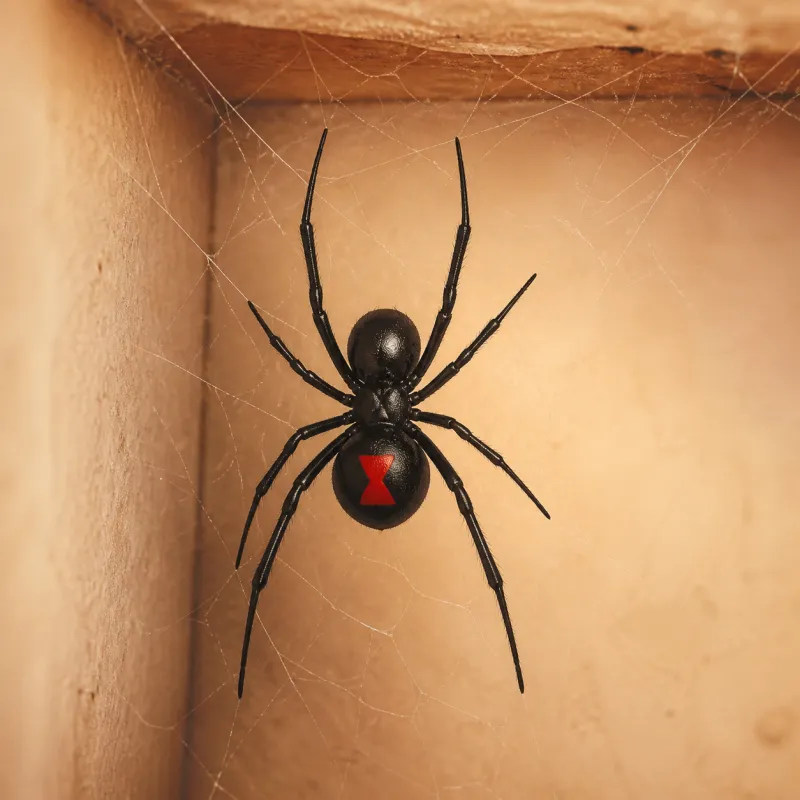
Expect a repeat schedule. Scorpions keep walking in from the desert and the neighbors' walls, which is why monthly or bi-monthly plans are the Tucson norm. Black widows share the same block wall voids, so a good scorpion program thins them out too; see spider control in Tucson if widows are the bigger worry.
Home sealing: the part that actually keeps them out
Sealing the house is the single most effective thing you can do about scorpions, and the University of Arizona Cooperative Extension says so in nearly those words: pest-proofing a structure is by far the most effective way to reduce scorpion contact. Treatment lowers the population. Sealing removes the doorway. You want both, but if you can only afford one this year, seal.
- Tight door sweeps on every exterior door, including the garage side door, with no daylight underneath
- Fresh weather-stripping on doors and windows and a new rubber seal along the bottom of the garage door
- Coarse steel mesh over weep holes in stucco weep screed and block walls, not caulk, so they still drain
- Caulk around pipe and conduit penetrations, hose bibs, the AC line set and the dryer vent
- Repaired window screens and sealed gaps where stucco meets foundation or roofline
- Capped block walls and filled expansion joints in patios and walkways
- Yellow bug lights instead of white porch bulbs, firewood off the ground and away from the house, pots and debris pulled back from the walls
Sealing crews in Tucson typically price by square footage. It is also the best winter project you can schedule: scorpions are clustered and sluggish from November through March, and you get ahead of spring. If you want to work through the job yourself first, our guide to scorpion-proofing a Tucson home walks the whole sequence, gap by gap, including the lighting and landscaping changes most homeowners skip.
Typical scorpion control cost in Tucson
These are typical market ranges across the Tucson metro, not a quote. The provider you are connected with sets the price after seeing the home, and a house backed up to a wash in Oro Valley or the Catalina Foothills prices differently from a midtown townhome.
| Service | Typical Tucson range |
|---|---|
| Initial visit on a recurring plan (inspection plus first treatment) | Roughly $100 to $300 |
| Monthly plan | Roughly $35 to $75 per month |
| Bi-monthly plan | Roughly $60 to $120 per visit |
| One-time scorpion treatment, no plan | Roughly $150 to $400 |
| Professional home sealing | Roughly $500 to $2,500 depending on square footage and how complete the job is |
| Night-time UV inspection | Often included with the initial visit; ask |
What moves the price: square footage, how much block wall is on the property, how much harborage has to be treated or removed, and whether sealing is bundled. To time your first treatment, read our month-by-month guide to scorpion season in Tucson. To see scorpion plans priced next to termite, roof rat and bed bug work, our guide to pest control cost in Tucson by service lays them side by side.
What to check before you hire
Every pest control business and applicator in Arizona must be licensed by the Arizona Department of Agriculture, Pest Management Division. Ask for the license number. Then ask the scorpion-specific questions:
- Will you dust the block wall voids and weep holes, or only spray the perimeter?
- Do you inspect with a UV light, and can I get a count before and after?
- What is the re-service policy if I keep finding scorpions indoors between visits?
- Do you do sealing in-house, and is it warrantied?
The providers in our network are independent and licensed. When you call, you are routed by ZIP code to one that covers your part of the metro, whether that is central Tucson, Marana, Vail or Sahuarita. For everything else crawling around the house, start at pest control in Tucson.
How the call works
- Tell us what you are seeing. Scorpions in the garage, mud tubes on the stem wall, a rat in the engine bay. A few details are enough.
- Get routed by ZIP code. Your call goes to an independent, licensed provider that actually covers your part of the Tucson metro.
- Book on the same call. Most providers can quote an inspection or treatment window right away.
Same-day or overnight service depends on which providers are taking calls in your part of Tucson, how many technicians are free and how busy the week is. Nobody can promise it, and capacity shifts from one neighborhood and one week to the next.
Frequently asked questions
Can an Arizona bark scorpion kill you?
Deaths are extremely rare. Healthy adults almost always get through a bark scorpion sting with pain, numbness and tingling that fade over a few days, and the Arizona Poison and Drug Information Center manages most cases at home by phone. The real risk is in small children, the elderly and people with breathing problems, so any sting in those groups gets a Poison Control call right away. An FDA-approved antivenom exists for severe cases.
Do scorpions in Tucson come up through the drains?
No. The P-trap under a sink or tub holds water, and a bark scorpion in your bathtub almost always fell in from the wall or ceiling and could not climb back out on slick porcelain. That is why you find them there in the morning. The fix is sealing the doors, windows and wall penetrations they used to get inside, not pouring chemicals down the drain.
I found one scorpion inside. Do I have an infestation?
One scorpion is a warning, not a verdict. Bark scorpions wander in from block walls and neighbors' yards, so a single visitor can be bad luck. One carrying babies on its back, or two or more inside within a month, means there is a population close to the house. A night-time UV walk around the perimeter will tell you quickly which situation you are in.
How long does it take for scorpion treatment to work?
Most Tucson homeowners see fewer scorpions within a couple of weeks of the first treatment, but scorpions keep arriving from the surrounding desert, so providers treat monthly or bi-monthly through the warm months. Sealing the home is what produces lasting results. Treatment without sealing usually means paying to manage a steady trickle instead of stopping it.