
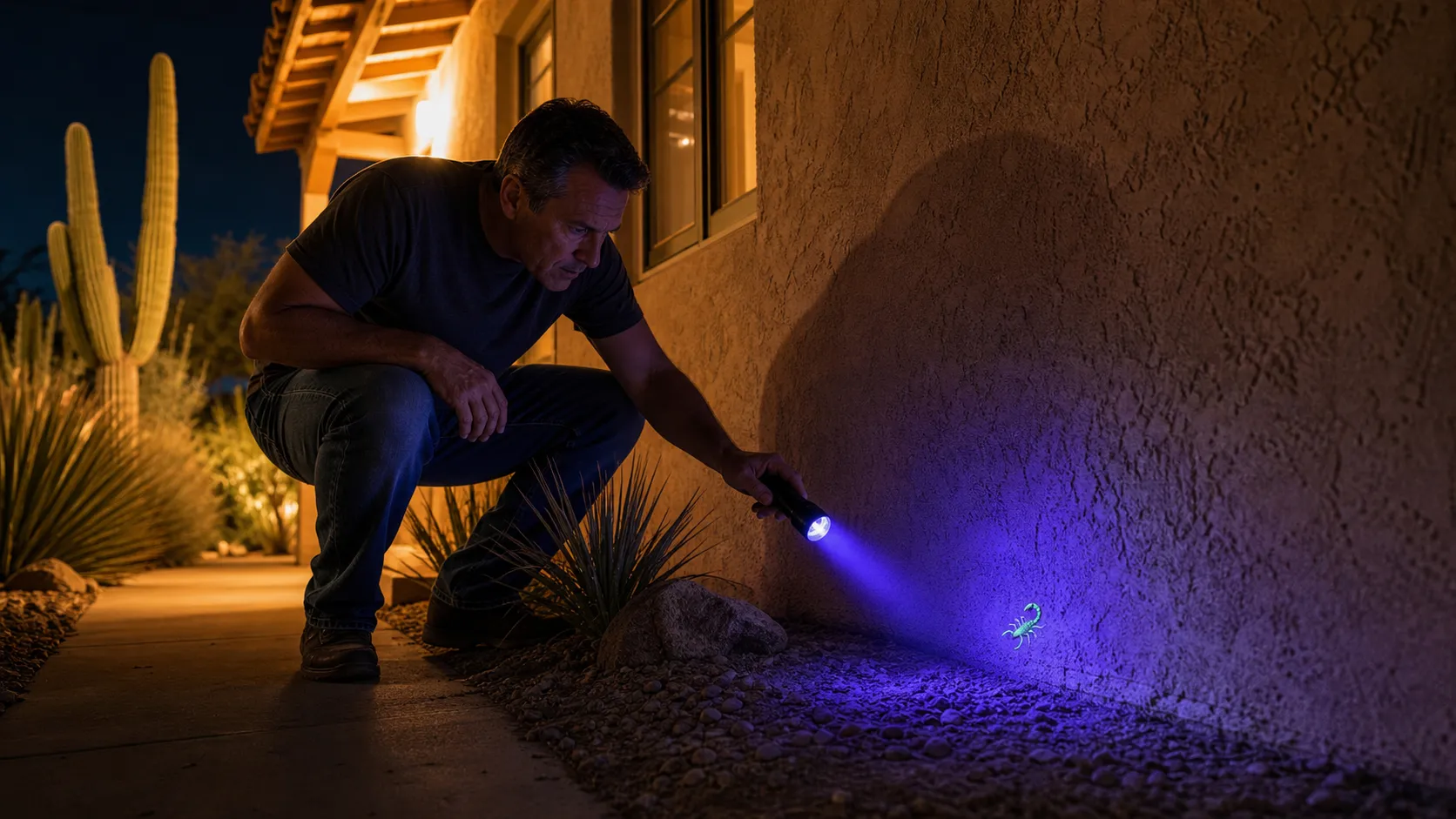
How bark scorpions get into a Tucson house
Bark scorpions get in at ground level and at the roofline, through openings you would never call gaps. The University of Arizona Cooperative Extension publication Scorpions (AZ1768) gives the working number: seal anything larger than one sixteenth of an inch. In a Tucson house that means the slot under a tired door sweep, the continuous opening behind the weep screed at the base of the stucco, an unscreened weep hole in a block wall, and the ring of daylight where the air conditioner line set passes through the wall.
Two traits turn this animal from a desert curiosity into a house problem. The bark scorpion climbs, and the extension notes it handles rough surfaces easily, so stucco, block, drywall and mesquite bark are all highways and your roof is in play. It is also flat. It folds into a space you would not slide a business card into and sits there all day, motionless, waiting for dark.
What waiting until July actually looks like
Waiting means a bark scorpion inside the house on a hot night, and the bark scorpion is the one in Arizona whose sting sends people to an emergency room. Picture the ordinary version, because the ordinary version is bad enough.
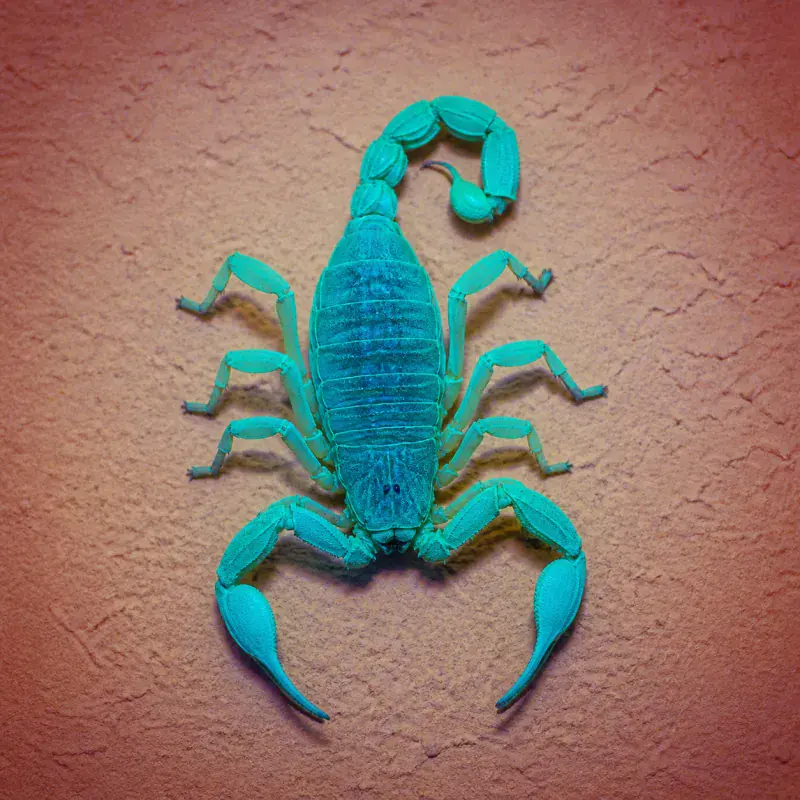
It is 2 a.m. in late July. The tile is still warm under your feet. You get up for water and you do not turn on the light, because you know this house. What you do not see is three inches long, straw-colored, and has been sitting motionless on the wall above the light switch for the better part of an hour, waiting for a cricket to walk underneath it. That is the good outcome. At least you could have seen it.
Now the other version. It is in the beach towel that spent the day on the bathroom floor, or the shoe in the hall closet, or under the top sheet at the foot of your daughter's bed, because it walked in under a door with a worn sweep, climbed the drywall and dropped. She wakes up screaming and cannot tell you where it hurts, because a bark scorpion sting leaves almost nothing to point at: no swelling, no wound, just pain like a hot needle and then numbness climbing her arm. Twenty minutes later her eyes will not stop roving and her arm is jerking. You are standing in a hallway at 2:40 in the morning reading a poison center nurse the name of the nearest emergency room.
That night is not rare here. The Arizona Poison and Drug Information Center in Tucson answers between 900 and 1,500 scorpion sting calls a year. Most of them end at home, on the phone, fine. Small children, older adults and people with heart or breathing conditions are the ones who get the bad version. That is the entire argument for spending one weekend with a caulk gun.
Sealing: the part that does the most work
Sealing beats every other scorpion-proofing measure, and the University of Arizona Cooperative Extension does not hedge about it: pest-proofing your home is by far the most effective way to reduce scorpion contact. Treatment lowers the population outside. Sealing removes the doorway. Work the list roughly in this order, because the top three cover most Tucson houses.
| Entry point | Why a bark scorpion uses it | The fix |
|---|---|---|
| Exterior door thresholds | If you can see daylight underneath, the gap is far past one sixteenth of an inch | New door sweep, adjust the threshold until no daylight shows, front and garage side doors first |
| Garage door bottom and side jambs | The garage is the busiest entry on most Tucson houses, and it gets left open at dusk | Fresh rubber bottom seal, seal the side jambs, close the door before dark |
| Weep screed at the base of the stucco | A continuous slot running the entire perimeter of the house | Coarse steel mesh, never caulk |
| Weep holes in block or brick veneer | They lead straight into the hollow cores where the population lives | Coarse steel mesh, never caulk |
| Utility penetrations | Air conditioner line set, hose bibs, gas and electrical entries, cable, dryer vent | Sealant or foam, plus mesh on the larger openings |
| Windows and screens | Loose frames and torn screens on bedrooms are the ones that matter at night | Fresh weather-stripping, screens that fit tight in the frame |
| Expansion joints and foundation cracks | Slab joints and patio cracks run underneath the house | Backer rod and a flexible polyurethane sealant |
| Roofline, eaves and attic vents | Branches touching the roof give them a path up, and the extension says so directly | Screen the vents, close the tile line, cut the branches back off the roof |
One rule people get wrong: do not caulk weep holes or weep screed shut. The extension is specific that those openings ventilate and drain the wall cavity, so they get coarse steel mesh and nothing else. Plug them and you have traded scorpions for rot, which is a worse trade than it sounds.
Lighting: stop running a cricket buffet
Lighting matters because bark scorpions follow their food, and your porch light is what delivers it. AZ1768 recommends yellow or sodium vapor bulbs outdoors, since they attract fewer insects. Fewer crickets and moths at the door means fewer reasons for a hunter to spend the night on your wall.
A bright white bulb over the front door is the prettiest thing on a Tucson porch and the single worst idea on it. Three fixes, cheapest first: swap to yellow bug bulbs, move the main light off the house onto a pole eight or ten feet out so the insects gather there instead of at your threshold, and put the rest on motion sensors. Then close the garage before dark rather than after the last trip to the trash can. If you already have sewer roaches working the patio slab at night, handle them too. They are scorpion groceries.
Landscaping: keep the first two feet boring
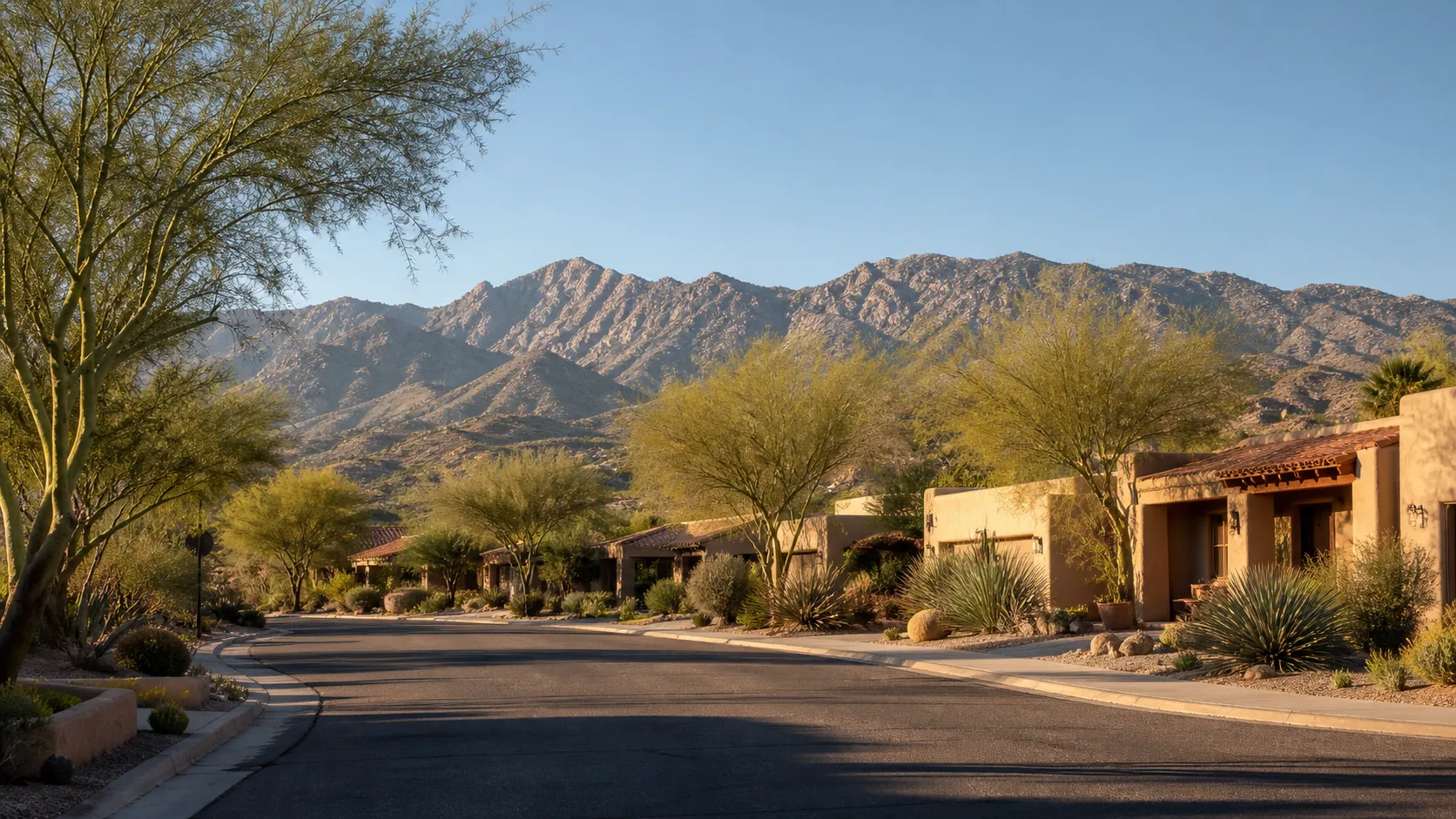
Landscaping is where Tucson homeowners accidentally build scorpion housing. The University of Arizona Cooperative Extension says not to let wood, rocks, clutter or debris build up against the home, to keep grass cut short near the walls, and to prune bushes and overhanging tree branches away, since branches are a path to the roof.
The practical version is a dull strip of ground, a foot or two wide, hugging the whole house with nothing stacked in it. The usual offenders around here: a decorative river-rock bed poured right against the stem wall, firewood for the chiminea, a stack of leftover pavers, terracotta pots leaning on the stucco, an unskirted palm, and a palo verde branch resting on the roof tile. Then walk your drip line. A leaking emitter beside the foundation hands them water, and water is the one thing this desert does not give away.
- Pull rock, bark mulch, pots and pavers back off the wall and keep that strip bare
- Get firewood off the ground and away from the house entirely
- Cut back every branch that touches the roof or an exterior wall
- Skirt palms, clear dead fronds and remove dead agave leaves
- Repair leaking drip emitters and hose bibs, and route air conditioner condensate away from the foundation
- Cap open block walls and close the gap where a garden wall meets the house
Inside the house: the bedroom is what people skip
Inside work takes one evening and it is the part that decides whether anyone gets stung. Bark scorpions climb rough surfaces well, but they cannot get up smooth glass or polished metal, which is the most useful piece of physics available to a desert homeowner. Set the legs of a crib or a bed in glass jars or smooth metal cans and nothing is climbing into it.
- Pull the bed away from the wall, lose the bed skirt that touches the floor, and keep bedding and towels off the floor
- Shake out shoes, towels, laundry and the pool bag before you use them, every time, all summer
- Do a UV walk before bed. Scorpions glow under ultraviolet light, and the extension flatly recommends inspecting inside the house with a blacklight before bedtime
- Set glue boards along garage walls, closet baseboards, under sinks and behind the water heater. They catch scorpions, and more usefully they show you which room they are coming in through
- Keep long tongs and a jar by the back door. Never a hand, never a flip-flop
If you are deciding when to do all this, our month-by-month guide to Tucson scorpion season makes the case for December through February, while they are clustered and slow.
When DIY is not enough
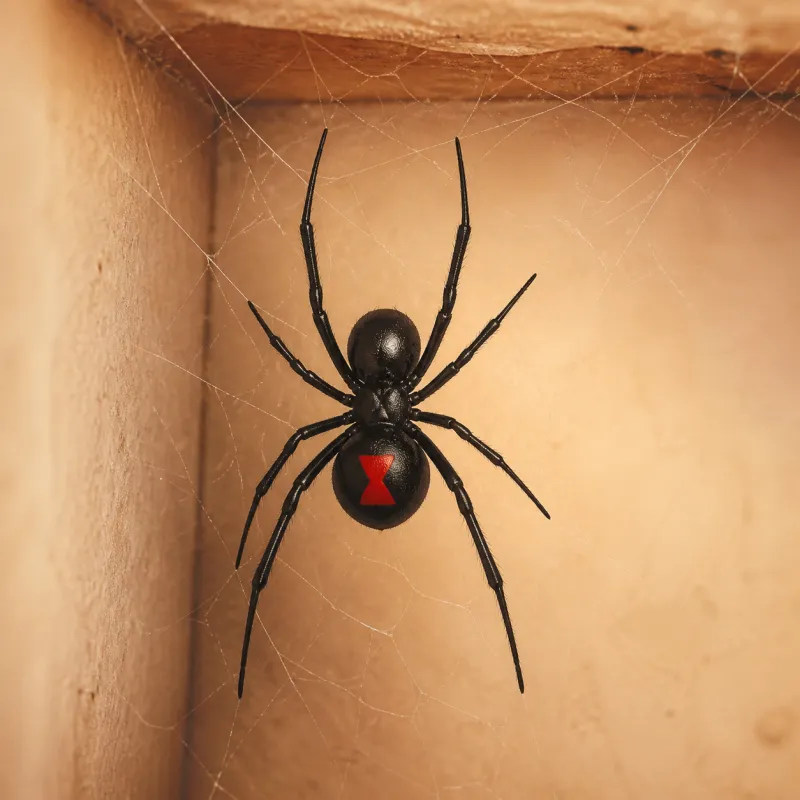
Sealing and lighting solve most Tucson houses, and the honest limit is worth stating: the University of Arizona Cooperative Extension says scorpions are difficult to manage with pesticides alone, which also means the can of spray at the hardware store is not the answer you were hoping for. These are the signs your case has moved past self-treatment.
- You are still finding them inside after a full seal-up, which usually means they are already living in the wall voids rather than walking in from outside
- A UV walk turns up more than a handful on the house itself, on the stucco, in the eaves, around the doors
- You find one carrying pale young on her back, which means a breeding population against your foundation
- Someone in the house has already been stung, or a child under six, an adult over 65, or someone with a heart or breathing condition sleeps there
- The harborage is structural: shared block walls you cannot dismantle, a weep screed run across a two-story elevation, a roofline you have no business standing on
If two of those describe your house, the sensible next step is a phone call, not another trip to the hardware store. Call (888) 217-8578 and you are routed by ZIP code to a licensed, independent local provider covering your part of the metro, from midtown to the Foothills to Oro Valley and Marana. They can dust the hollow block cores and weep screed runs you cannot reach, tell you which gaps on your particular elevation actually matter, and usually price the sealing work on the same visit. What that service involves is laid out on our scorpion control in Tucson page.
And if tonight is already the bad night, our guide on what to do in the first hour after a bark scorpion sting covers the first aid and the symptoms that mean go to a hospital.
Here is the reassuring part, and it is true. A sealed, yellow-lit, boringly landscaped Tucson house is genuinely hard for a bark scorpion to get into. You are not fighting the desert. You are replacing a door sweep, screening eight weep holes, changing two bulbs and moving a pile of pavers off a wall. Plenty of people here do exactly that over one weekend and then spend years not thinking about it.
How the call works
- Tell us what you are seeing. Scorpions in the garage, mud tubes on the stem wall, a rat in the engine bay. A few details are enough.
- Get routed by ZIP code. Your call goes to an independent, licensed provider that actually covers your part of the Tucson metro.
- Book on the same call. Most providers can quote an inspection or treatment window right away.
Same-day or overnight service depends on which providers are taking calls in your part of Tucson, how many technicians are free and how busy the week is. Nobody can promise it, and capacity shifts from one neighborhood and one week to the next.
Frequently asked questions
Can you scorpion-proof a Tucson home completely?
Not completely, but you can get very close. Sealing every gap larger than one sixteenth of an inch, screening the weep holes and weep screed, fixing the door sweeps and pulling harborage off the walls removes almost every route a bark scorpion has into the structure. What you cannot do is stop them from living in the block walls around your yard, which is why most Tucson households pair a sealed house with a recurring treatment through the warm months.
Do bark scorpions really get in under a closed door?
Yes, and it is the most common way they do it. A worn door sweep leaves a slot wide enough to walk under, and the University of Arizona Cooperative Extension sets the threshold for sealing at one sixteenth of an inch. Kneel inside in the daytime with the lights off: any daylight along the bottom or the sides of the door is an open invitation. A new sweep costs a few dollars and fixes more than anything else on the list.
Does spraying the yard keep scorpions out?
Not on its own. The University of Arizona Cooperative Extension notes that scorpions are difficult to manage with pesticides alone, partly because a scorpion walks on the tips of its legs and barely touches a treated surface, and partly because it can wait out a barrier inside a wall void for weeks. Treatment lowers the population outside the house. Sealing is what keeps them out of it.