

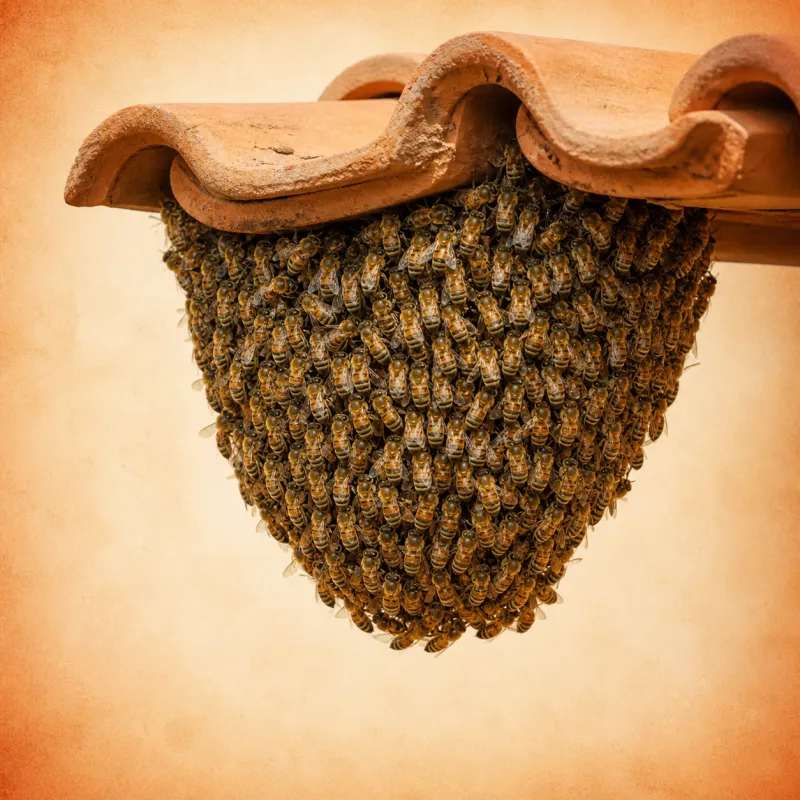
Is the swarm in your yard Africanized?
Yes, treat any swarm in a Tucson yard as Africanized. The University of Arizona Cooperative Extension says any wild honeybee you come in contact with in Arizona should be considered Africanized, and they were first seen in the state in 1993. You cannot check by eye. Extension agent Jeff Schalau calls them virtually indistinguishable from European honeybees, and the Southern Arizona Beekeepers Association says only genetic testing or morphometric analysis settles it. So skip the ID and go by behavior.
Now the part that should lower your pulse. A resting swarm is a colony between homes, with no brood or honey to guard, hanging off a branch while scouts go house hunting. The Extension calls swarms at this stage generally not aggressive and traces most attacks to someone disturbing a hive.
What happens if the swarm moves in
The worst case with an Africanized swarm in Tucson is not the cluster on the branch. It is the swarm that moves into your wall and stays. Say it lands on the palo verde by your patio in April and you decide to give it the weekend. The scouts come back with an address: the hollow cells of your block fence, or the water valve box by the driveway with the lid that never quite fit. The USDA's Carl Hayden Bee Research Center, right here in Tucson, says Africanized bees are far less selective about a home than European bees and will occupy a much smaller space. By June there is comb in that wall, and something to defend.
Picture a Saturday in June. Coffee on the patio, the dog asleep on the warm pavers, and you pull the cord on the weed eater along that wall. The Extension names lawnmowers, weed eaters and other power equipment as common triggers, and notes that the smell of fresh cut grass riles honey bees. The first warning is a few bees bumping your face or buzzing over your head. Then the wall empties. They go for your face and eyes, and once your vision goes, the Extension says, so does your chance of getting away. The dog on the patio cannot open the slider. In May 2020, KGUN 9 reported that Tucson Fire crews foamed an aggressive colony near Golf Links and Wilmot after the bees killed three dogs.
For a healthy adult the danger is numbers. The Arizona Poison and Drug Information Center says it can take hundreds of stings to reach a fatal dose, but one sting can kill someone who is hypersensitive.

What to do in the first hour after you spot a swarm
The first hour with a bee swarm in Tucson is about distance and quiet, not about the bees. Here is what to do:
- Get people and pets inside and close the dog door.
- Give it room. The USDA bee lab in Tucson tells people to stay at least 100 feet from an Africanized hive, about the width of a four-lane highway. Give a swarm the same.
- Kill the noise. No mowing, blowing or trimming nearby, and warn your landscaper.
- Do not hose it, spray it or knock it into a box. The Southern Arizona Beekeepers Association says people should not try to move or exterminate honey bees themselves.
- Dress light if you must walk past. The Extension says bees tend to go after dark things, dark hair and clothes included.
- Watch it from a window. Tucson Fire Captain Barrett Baker told KGUN 9 that a calm swarm in a tree usually moves on in about 24 hours.
If bees come after you, run. Pull your shirt over your face and head for the nearest house or car. A honey bee flies about 12 to 15 miles per hour, and the Extension says most healthy people can outrun one and that Africanized bees have followed people more than a quarter mile, so keep going. Skip the pool; the bees wait for you to surface. Inside, call 911 if bees are attacking a person or an animal, scrape stingers out within seconds, and call the Arizona Poison and Drug Information Center at 1-800-222-1222 if symptoms get worse fast.
Then do the dull work that keeps next spring's scouts out. The Extension's list: steel wool and caulk in wall cracks, a cover on the valve box hole, filled ground holes and no junk piles, because bees will nest in an overturned flower pot. The gap sealing in our guide to scorpion-proofing a Tucson home does double duty here.
Swarm or colony: read what you are looking at
A swarm is passing through and a colony is defending a home, and that difference decides what you do next. Match what you see:
| What you see | What it usually means | What to do |
|---|---|---|
| A ball of bees hanging from a branch, eave or fence, no comb showing | A resting swarm | Keep people and pets away and watch it for a day |
| The same cluster still there after two or three days, or pale wax showing | The swarm is building a home | Call; it is turning into a colony |
| A steady line of bees in and out of one small hole in a block wall, valve box, meter box or soffit | A colony has moved in | Call; do not plug the hole or spray it |
| A hum behind the drywall, or bees turning up inside the house | Comb inside the structure | Keep that room shut and call |
| Bees bumping your face or following you as you walk past | A defensive colony nearby | Go inside, stay clear of that side of the yard and call |
When DIY is not enough
DIY is not enough once the Africanized swarm stops being a visitor and becomes a resident. These are the signs:
- The cluster is still there after two or three days, or you can see wax comb.
- Bees are flying in and out of one opening in the house, the block fence, a meter box or a valve box.
- You hear humming inside a wall or keep finding bees indoors.
- Bees have bumped, chased or stung someone near the spot.
- It sits where nobody can avoid it: by the front door, the pool gate, the dog run or the swing set.
If one of those fits, the sensible next step is a phone call, not a can of spray. Call (888) 217-8578 and we connect you with a licensed local provider who can remove the bees, cut out the comb and seal the opening so the empty cavity does not invite the next swarm. Typical market ranges, not a quote: roughly $100 to $300 for a reachable swarm, $250 to $500 for an accessible colony, and $600 to $1,200 or more for a cutout inside a wall or roof. Our Tucson bee removal page explains live removal versus extermination and why the comb has to come out, and the Tucson pest control hub lists every part of the metro we route calls for.
And breathe. A ball of bees on the palo verde in April is the bee version of a moving truck idling at the curb: loud, a little alarming, and usually gone by tomorrow. Keep the kids and the dog in, keep the mower off, give it a day. If it unpacks instead, you know exactly what to do.

How the call works
- Tell us what you are seeing. A ball of bees on the palo verde, a steady line of bees into the block wall, a hum behind the drywall. A few details are enough.
- Get routed by ZIP code. Your call goes to an independent, licensed provider that actually covers your part of the Tucson metro.
- Book on the same call. Most providers can quote an inspection or treatment window right away.
Same-day or overnight service depends on which providers are taking calls in your part of Tucson, how many technicians are free and how busy the week is. Nobody can promise it, and capacity shifts from one neighborhood and one week to the next.
Frequently asked questions
How common are Africanized bees in Arizona?
Common enough that the University of Arizona Cooperative Extension says any wild honeybee you come in contact with in Arizona should be considered Africanized. They were first seen in Arizona in 1993 and have since been recorded statewide. Arizona beekeepers often re-queen the colonies they collect with European queens, but a wild swarm in a Tucson yard should be treated as Africanized.
How can you tell if a honey bee is Africanized?
You cannot tell an Africanized honey bee by looking at it. The University of Arizona Cooperative Extension calls them virtually indistinguishable from European honeybees, and the Southern Arizona Beekeepers Association says only genetic testing or morphometric analysis confirms it. Behavior is the practical clue: bees that fly at your face or follow you are defending something, so back off.
What should I do if a swarm of bees lands in my yard?
Bring people and pets inside, keep well back and turn off mowers and blowers nearby. A Tucson Fire Department captain told KGUN 9 that a calm swarm in a tree usually moves on in about 24 hours. If the bees are still there after two or three days, are building comb or are moving into a wall or box, call for removal. Call 911 only if bees are attacking a person or an animal.
Where can I get free bee removal in Tucson?
Free bee removal in Tucson is hard to find. Tucson Fire steps in when bees are attacking, not for calm swarms, and the Southern Arizona Beekeepers Association notes that beekeepers do charge for removing honey bee colonies. The cheapest removal is almost always a swarm caught early, before it moves into a wall and builds comb that has to be cut out.